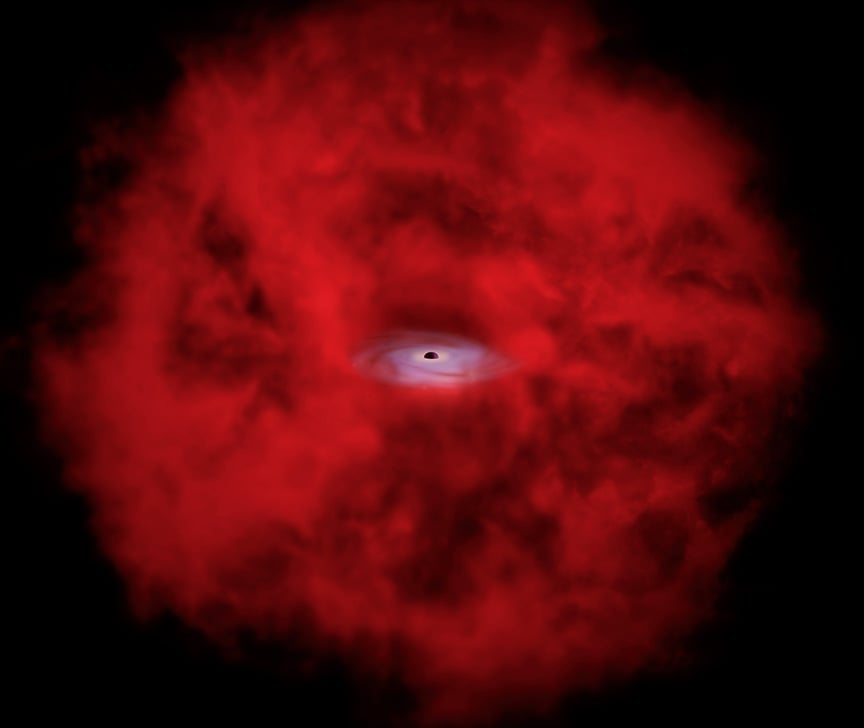
Un étrange objet de l’Univers primordial alimente un grand débat
Depuis que le télescope spatial James Webb a commencé à renvoyer des vues profondes en infrarouge de l’Univers lointain, les astronomes tentent d’expliquer l’une de ses découvertes les plus déroutantes : des objets compacts désormais connus sous le nom de « petits points rouges ». Ces sources apparaissent en grand nombre à des décalages vers le rouge très élevés, ce qui signifie qu’elles sont observées à une époque où l’Univers était encore très jeune. D’après les observations rapportées, beaucoup d’entre elles se trouvent à environ 12 milliards d’années-lumière et auraient commencé à se former quelque 600 millions d’années après le Big Bang.
Ce calendrier compte. Des objets apparus si tôt ont des implications immédiates sur la vitesse à laquelle les trous noirs, les galaxies et les premières générations d’étoiles ont pu se former. Le problème est que les petits points rouges n’entrent pas facilement dans une seule catégorie établie. Ils apparaissent rouges en lumière optique et bleus dans l’ultraviolet, une combinaison inhabituelle qui a conduit à plusieurs explications concurrentes.
Une nouvelle observation, décrite à partir d’une comparaison entre des données de l’observatoire de rayons X Chandra et une étude profonde du JWST, ajoute une pièce potentiellement importante à ce puzzle. Les chercheurs ont trouvé un petit point rouge émettant des rayons X, un résultat surprenant car les autres membres de cette classe n’avaient généralement pas montré d’émission X. L’objet, nommé 3DHST-AEGIS-12014, se situe à environ 11,8 milliards d’années-lumière et semble partager les caractéristiques compactes et rouges qui définissent l’ensemble de la population.
Ce qui le distingue, c’est sa luminosité en rayons X. Les rayons X constituent un indice fort, car on sait que les trous noirs en accrétion et les structures qui les entourent en produisent. Cela ne résout pas instantanément le mystère de chaque petit point rouge, mais cela renforce l’idée qu’au moins certains de ces objets sont liés à la croissance des trous noirs dans le cosmos primordial.
Pourquoi les petits points rouges ont été si difficiles à classer
L’incertitude autour des petits points rouges vient du fait que plusieurs scénarios restent plausibles. Une idée est qu’ils soient alimentés par des régions autour de trous noirs supermassifs cachés derrière d’épaisses nuées de gaz. Une autre est qu’ils représentent une forme de galaxie primitive que les astronomes ne comprennent pas encore totalement. Ils ont aussi été envisagés comme une sorte de noyau galactique actif, ce qui impliquerait également une activité de trou noir. Une proposition plus exotique avance que certains pourraient être des étoiles supermassives, pauvres en métaux et de courte durée de vie, parfois décrites comme des « étoiles trou noir ».
Chaque explication capture une partie des données disponibles, mais aucune n’a clos le dossier. Si des trous noirs cachés en sont la cause, les chercheurs doivent expliquer pourquoi beaucoup de petits points rouges ne semblent pas présenter les mêmes signatures que celles attendues de trous noirs supermassifs en croissance rapide à cette époque. S’il s’agit de galaxies, les astronomes doivent rendre compte de leurs propriétés d’émission inhabituelles. S’ils sont liés à un stade intermédiaire de la formation des trous noirs, alors les observations qui relient un état à un autre deviennent particulièrement précieuses.
C’est là que 3DHST-AEGIS-12014 devient intéressant. Les informations autour de la source suggèrent qu’elle pourrait représenter un cas de transition. Si l’objet héberge bel et bien un trou noir, le gaz environnant pourrait être consommé par un disque d’accrétion, ouvrant progressivement des canaux plus clairs par lesquels les rayons X peuvent s’échapper. Dans ce scénario, l’objet ne serait pas seulement un membre de plus de la population des petits points rouges. Il constituerait une image d’un changement en cours, montrant comment un système fortement obscurci pourrait évoluer vers quelque chose de plus reconnaissable comme un trou noir actif.

Un pont possible entre des idées concurrentes
L’aspect le plus convaincant de la nouvelle détection n’est pas simplement l’existence d’une source de rayons X, mais le fait qu’elle puisse relier deux idées souvent discutées séparément : les sources compactes inhabituelles de l’Univers jeune et l’essor rapide des trous noirs supermassifs. Les astronomes se heurtent depuis longtemps au problème d’expliquer comment des trous noirs extrêmement massifs ont pu se former si vite dans l’Univers jeune. Tout objet pouvant plausiblement tracer un stade intermédiaire est donc précieux.
Dans ce cas, la taille compacte de l’objet, son apparence rouge et sa position dans l’Univers primordial le placent dans le même régime général que les autres petits points rouges. Son émission en rayons X, en revanche, pointe vers des processus énergétiques associés à l’accrétion. Cela ne prouve pas que chaque petit point rouge est un objet alimenté par un trou noir, mais cela suggère que la classe n’est peut-être pas uniforme. Certains pourraient être des systèmes de trous noirs obscurcis, d’autres des formes transitoires, et d’autres encore pourraient nécessiter des explications différentes.
Cette possibilité est scientifiquement utile. Les astronomes commencent souvent par une catégorie qui semble cohérente dans les images et les spectres, puis découvrent plus tard qu’elle contient plusieurs phénomènes physiques. JWST a ouvert une vue de l’Univers primordial suffisamment détaillée pour créer exactement ce type de problème taxonomique. La phase suivante consiste à distinguer l’apparence de la physique sous-jacente.
La détection rapportée renforce aussi l’intérêt de combiner des observatoires plutôt que de dépendre d’un seul instrument. JWST peut identifier ces sources faibles et lointaines en lumière infrarouge, mais Chandra offre un test différent en demandant si les mêmes objets sont aussi énergétiques en rayons X. Lorsque les réponses diffèrent d’un objet à l’autre, ce décalage devient lui-même une preuve.
Et ensuite
La question immédiate est de savoir si 3DHST-AEGIS-12014 est un cas rare isolé ou le premier membre clairement identifié d’un sous-groupe plus vaste. Si l’on trouve davantage de petits points rouges brillants en rayons X, les astronomes auront de meilleures bases pour affirmer que la croissance des trous noirs est centrale pour cette population. Sinon, cette source pourrait tout de même compter comme une exception inhabituelle mais instructive.
Dans tous les cas, cela aiderait. Un objet rare peut encore révéler une voie physique que les théoriciens doivent intégrer. Un objet fréquent obligerait à une révision plus importante des modèles actuels de formation des trous noirs et des galaxies dans l’Univers primordial. Dans les deux cas, la découverte met la pression sur les explications simplistes.
L’enjeu plus large est que l’Univers primordial s’avère plus peuplé et plus complexe que bien des attentes d’avant JWST ne le laissaient penser. Les petits points rouges étaient déjà un défi parce qu’ils apparaissaient en nombre, étaient compacts et difficiles à expliquer. L’apparition d’un exemple brillant en rayons X relève encore la barre. Elle suggère qu’au moins certaines de ces sources rouges lointaines pourraient être liées à la mécanique qui construit les premiers trous noirs massifs.
Pour l’instant, le mystère n’est pas résolu. Mais il est devenu plus net. Au lieu de se demander seulement ce que sont les petits points rouges en général, les astronomes peuvent commencer à se demander quels types existent, quelles étapes ils représentent et comment ils se relient à l’histoire la plus ancienne de la croissance des trous noirs. C’est un problème plus précis et plus productif, et c’est le genre de progrès qui marque souvent une véritable avancée en astronomie.
Cet article s’appuie sur un reportage de Universe Today. Lire l’article original.

Originally published on universetoday.com