A surprising structure in a stellar nursery
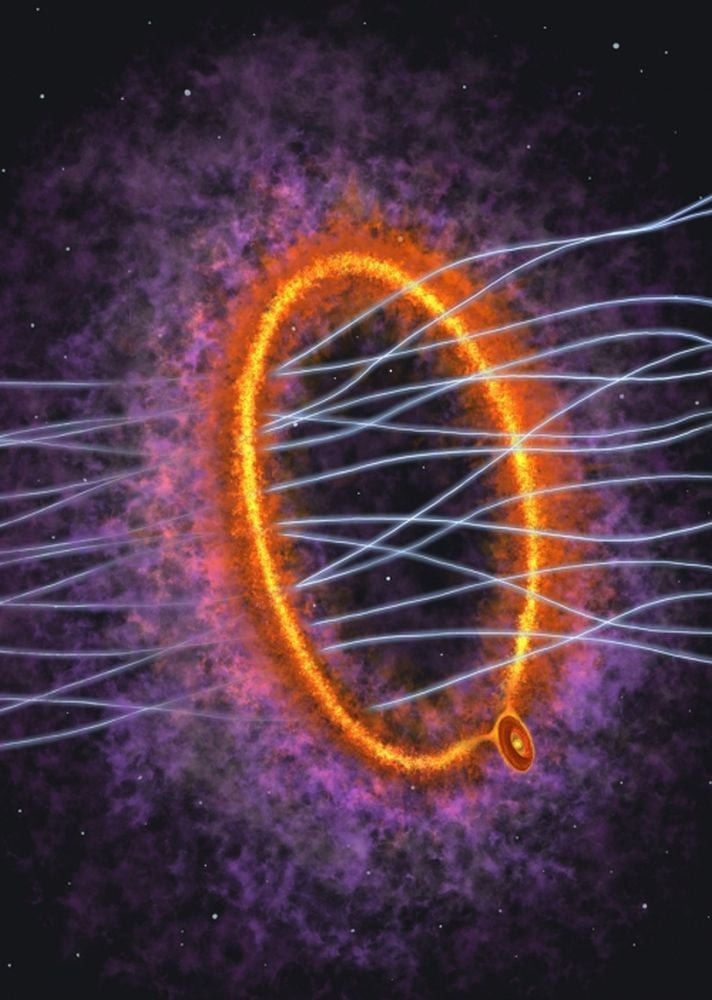
Astronomers studying a deeply embedded young protostar in the Taurus Molecular Cloud have identified a giant warm gas ring roughly 1,000 astronomical units in size, a finding that could reshape how researchers think about the earliest stages of star growth. The observation was made with the Atacama Large Millimeter/submillimeter Array, or ALMA, using its Band 9 capabilities to probe dense gas around the object known as MC 27/L1521F.
The newly reported structure is notable both for its size and for what it may represent physically. The source article describes the ring as being associated with magnetic flux linked to the protostellar disk. That implies the feature may not be a passive shell of material, but part of a dynamic process through which a forming star releases energy and manages the conditions needed to continue accreting mass.
Why young stars are still difficult to understand
Star formation is one of astronomy’s most familiar subjects and one of its most stubbornly difficult. The basic outline is known: dense clouds of gas collapse under gravity, a protostar forms, a disk surrounds it, and matter continues to spiral inward while outflows, jets, and magnetic processes regulate the system. But the details remain hard to observe because the earliest stages are buried inside thick dust and gas.
That is where ALMA has become unusually powerful. Operating at wavelengths between radio and infrared, the observatory can detect molecular transitions and look through the obscuring material that blocks optical telescopes. Those wavelengths are especially useful for following molecules such as carbon monoxide and for examining the dense, warm environments close to young stars.
In this case, researchers used ALMA’s Band 9 to study the gas around MC 27, a protostar already known for unusual activity. Earlier work by the same research group had identified spike-like structures about 10 astronomical units long emerging from the protostellar disk. The team described those structures as “sneezes,” suggesting they may help the young star shed excess energy so it can keep growing.

From small spikes to a giant ring
The newly observed ring scales that idea up dramatically. Instead of a compact local feature near the disk, the research points to a much larger structure extending roughly 1,000 astronomical units. The source describes it as a warm ring of gas associated with the embedded protostar and linked to magnetic field lines threading the region.
That combination is important. Magnetic fields are widely believed to play a central role in star formation, influencing how material moves, how angular momentum is redistributed, and how a growing protostar avoids spinning or heating itself into instability. Yet magnetic processes are difficult to observe directly. Large-scale structures shaped by magnetic flux therefore offer some of the clearest clues available.
If the ring is indeed part of the star’s mechanism for regulating its growth, it may represent a previously underappreciated channel through which infant stars interact with their surroundings. Rather than confining the key action to the immediate disk and narrow jets, the finding suggests that energy and magnetic structure can organize matter on much larger scales during the embedded phase.
Why Band 9 mattered
The source emphasizes ALMA’s ability to operate in a wavelength range that interacts with molecular rotation and penetrates dense birth clouds. Band 9 is especially useful for probing warm, dense gas near young stars. That gave the researchers access to material that might otherwise remain hidden, and it is central to why this ring could be identified at all.
For star formation studies, that observational advantage is critical. Many theoretical questions now depend less on whether astronomers know the rough sequence of events and more on whether they can resolve the structures that control the flow of matter and energy at each step. The giant ring around MC 27 appears to be one of those structures.
The work also underscores how much of protostellar evolution may still be invisible without the right instruments. If similar rings exist around other embedded protostars, they may have gone undetected simply because the observations needed to isolate them are demanding.
Implications for how stars keep growing
The central problem in early star formation is not only how a cloud collapses into a protostar, but how the object continues to grow without being choked by its own angular momentum, heat, and magnetic complexity. Observations of outflows, jets, and disk instabilities have all contributed pieces of the answer. The newly reported ring may add another.
The interpretation offered in the source suggests that releasing excess energy is necessary for continued growth. The earlier “sneeze” structures hinted at one mechanism. The much larger warm ring could be part of a related process operating across a broader environment. If so, the protostar is not simply accreting material from a quiet reservoir. It is actively reorganizing its natal cloud through magnetic and thermal interactions.
That would have consequences for how astronomers model the mass buildup of young stars and the initial conditions of planetary systems that may later emerge from the same disk environment. The earliest architecture of a stellar system is shaped by these formative exchanges between the star, the disk, and the surrounding gas.
A reminder that stellar nurseries still hold surprises
Even with decades of study, stellar nurseries remain places where new observations can force revisions to established pictures. The detection of a 1,000-au warm gas ring around MC 27 does exactly that. It does not overturn the framework of star formation, but it introduces a feature large and structured enough to demand explanation.
For astronomers, the significance lies in the combination of scale, temperature, and probable magnetic connection. For the wider field, the finding is a reminder that star birth is not a simple collapse followed by quiet maturation. It is a turbulent, multi-scale process in which hidden structures can govern how a star survives its own beginnings.
As ALMA continues to probe embedded protostars at high resolution, more of those hidden structures are likely to come into view. The giant ring around MC 27 may be an outlier. It may also be the first clear sign of a common but previously obscured stage in how stars learn to grow.
This article is based on reporting by Universe Today. Read the original article.
Originally published on universetoday.com