Le problème du bin picking
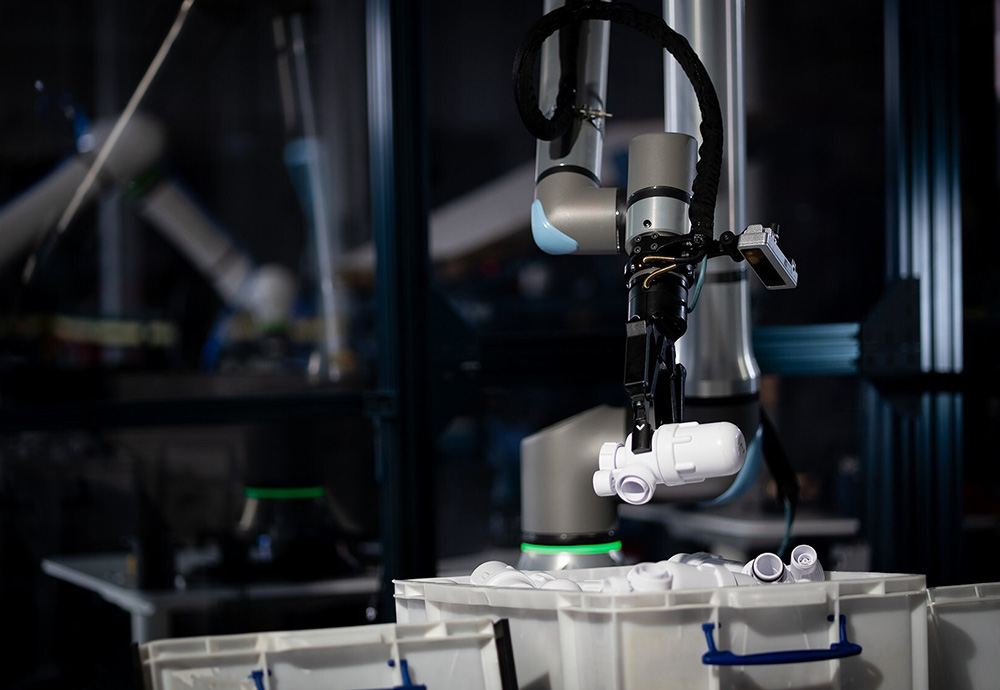
Dans le paysage des défis de l'automatisation industrielle, le deep bin picking occupe une place à part : il est difficile, économiquement important et résiste obstinément aux types de solutions programmatiques qui ont permis à l'automatisation robotique de réussir dans des applications plus structurées. La tâche semble simple - prélever des pièces orientées aléatoirement dans un bac et les placer correctement pour l'étape suivante d'un processus de fabrication - mais elle combine plusieurs défis techniques distincts qui, ensemble, ont rendu les solutions automatisées fiables difficiles à obtenir pendant des décennies.
Les pièces dans un bac profond sont orientées aléatoirement dans trois dimensions. Elles peuvent être emmêlées, empilées ou partiellement masquées par d'autres pièces. Les parois du bac créent des contraintes géométriques qui limitent les approches du bras robotique. Les surfaces des pièces varient en réflectivité, translucidité et texture d'une manière qui complique la vision machine. Et l'acte physique de saisir et d'extraire une pièce d'un amas désordonné nécessite un contrôle de force adaptatif : appliquer suffisamment de force pour saisir de manière fiable sans endommager la pièce, tout en gérant les interactions mécaniques avec les pièces environnantes qui se déplacent au fur et à mesure que des éléments sont retirés.
Pour les fabricants qui exploitent des installations à plusieurs équipes avec un volume élevé de pièces, ce défi représente un goulot d'étranglement important et un coût de main-d'œuvre. Les opérateurs humains peuvent gérer le bin picking de manière intuitive, en s'appuyant sur la perception visuelle et le retour tactile qu'ils mobilisent naturellement et sans programmation explicite. Mais le coût de la main-d'œuvre et la variabilité associés au bin picking manuel - en particulier dans les environnements de production high-mix où le portefeuille de pièces est vaste et change constamment - rendent l'automatisation attrayante si le niveau de fiabilité peut être atteint.
Ce que fait Rapid Operator AI
Rapid Operator AI de Vention répond au défi du bin picking grâce à une combinaison de vision machine adaptative, de politiques de préhension apprises et de contrôle en temps réel du retour de force. Le système utilise des caméras de profondeur et de la lumière structurée pour construire une représentation tridimensionnelle du contenu du bac, en identifiant les pièces individuelles et leurs orientations au sein de l'amas désordonné. L'estimation de la pose de préhension - le calcul de l'angle d'approche optimal, de l'orientation de la pince et des points de contact pour une prise réussie - est assurée par des modèles de réseaux neuronaux entraînés sur de vastes ensembles de données d'images de pièces et de tentatives de préhension réussies.
Le composant d'apprentissage automatique est essentiel à l'adaptabilité du système. Contrairement aux systèmes de vision machine basés sur des modèles qui exigent des modèles CAO précis et qui se dégradent lorsque les pièces s'écartent des orientations attendues, les modèles neuronaux de Rapid Operator AI peuvent généraliser à partir des données d'entraînement pour gérer des présentations inédites et de nouvelles géométries de pièces avec relativement peu de réentraînement. Pour les fabricants high-mix qui gèrent des dizaines ou des centaines de références différentes, cette capacité de généralisation fait la différence entre un système utile sur l'ensemble du portefeuille de production et un système qui fonctionne pour une famille de pièces spécifique mais nécessite un effort d'ingénierie important pour être étendu à d'autres.
L'intégration du retour de force traite le défi mécanique consistant à extraire des pièces d'un bac sans les endommager. Le système surveille les forces de la pince en temps réel, détectant lorsqu'une pièce est emmêlée ou lorsque le chemin d'extraction est obstrué, puis ajuste la trajectoire du robot en conséquence. Cette boucle de retour permet au système de gérer la mécanique stochastique d'un tas de pièces - les mouvements en cascade des pièces à mesure que des éléments sont retirés - sans les modes de défaillance fragiles qui affectent les systèmes de bin picking en boucle ouverte lorsque le monde réel s'écarte de la configuration attendue.
Marché cible et contexte de déploiement
Vention positionne Rapid Operator AI pour les fabricants de taille intermédiaire et les entreprises exploitant des installations à plusieurs équipes - un segment où l'économie de l'automatisation est convaincante, mais où les ressources en capital et en ingénierie nécessaires aux déploiements traditionnels de robots industriels ont historiquement constitué un obstacle. La plateforme plus large de Vention, qui offre un système d'automatisation modulaire à déploiement rapide avec programmation Web et assemblage mécanique rapide, est conçue pour réduire le temps et l'expertise nécessaires au déploiement de cellules robotiques, passant des mois requis par les projets traditionnels menés par des intégrateurs à quelques jours ou semaines.
Rapid Operator AI étend cette philosophie de déploiement rapide à la couche d'apprentissage automatique et de perception. Plutôt que d'exiger des fabricants qu'ils développent leur propre IA de bin picking ou qu'ils fassent appel à des fournisseurs spécialisés en IA robotique - un processus qui nécessitait traditionnellement une expertise considérable en apprentissage automatique et des mois de collecte de données spécifiques au système - le système est livré avec des modèles préentraînés qui peuvent être adaptés à des pièces spécifiques grâce à un processus d'onboarding structuré avec des besoins en données limités.
Contexte plus large: l'IA descend dans la pile robotique
Le lancement de Vention illustre une tendance plus large dans la robotique industrielle : l'intégration progressive des capacités d'IA à des niveaux plus bas de la pile d'automatisation, en déplaçant l'IA du niveau d'orchestration du système vers les sous-systèmes de perception et de contrôle du mouvement qui interagissent directement avec le monde physique. Cette tendance est rendue possible par la maturation de techniques telles que le deep learning pour la reconnaissance d'objets 3D, le reinforcement learning pour la manipulation riche en contacts, et les environnements de simulation à grande échelle qui permettent d'entraîner des modèles neuronaux sur des données synthétiques avant le déploiement physique.
La portée pratique de cette tendance pour les fabricants est que des capacités qui nécessitaient auparavant des travaux d'intégration coûteux et spécialisés sont de plus en plus disponibles sous forme de mises à jour logicielles ou de nouveaux produits au sein des plateformes qu'ils utilisent déjà. La barrière à l'entrée pour une automatisation sophistiquée alimentée par l'IA diminue non seulement en prix, mais aussi en expertise métier requise pour déployer et maintenir ces systèmes. Cette démocratisation des capacités - mettre l'IA adaptative de bin picking à la portée des fabricants de taille moyenne plutôt que des seuls grands producteurs automobiles ou électroniques - est potentiellement aussi importante que les avancées techniques sous-jacentes elles-mêmes.
Le bin picking ne sera pas le dernier domaine d'application où l'IA débloque une automatisation auparavant impraticable. Les tâches d'assemblage nécessitant une manipulation dextre, l'inspection qualité dans des environnements non structurés et la manutention dans des applications logistiques aux caractéristiques d'emballage très variables présentent tous des combinaisons similaires de perception visuelle et de manipulation riche en contacts. Les solutions développées pour le bin picking constituent des blocs de construction pour la prochaine génération d'automatisation industrielle, et la philosophie de déploiement rapide de Vention suggère que ces solutions pourraient atteindre l'atelier plus vite que les vagues précédentes de technologie d'automatisation.
Cet article est basé sur un reportage de The Robot Report. Lire l'article original.
Originally published on therobotreport.com