Automation starts before the robot turns on
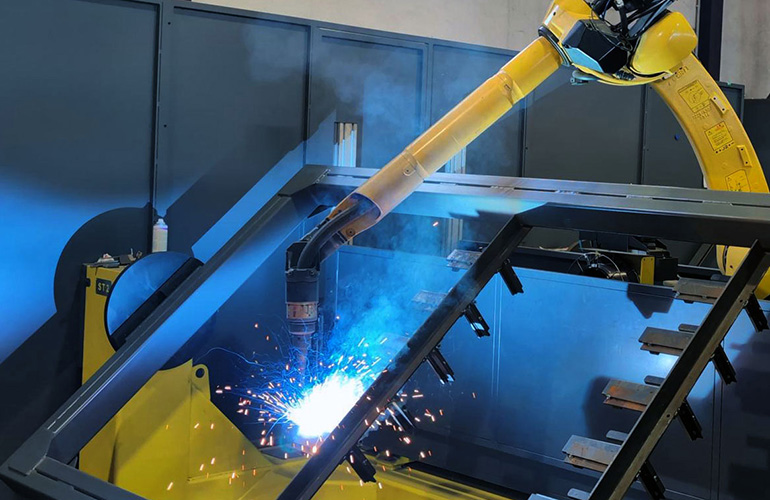
Industrial robotics stories often focus on the machine at the center of the frame. The more revealing detail is sometimes everything that had to be simplified around it first. According to The Robot Report, Dextall tripled production speed for high-rise facade components by standardizing its supply chain before deploying proprietary robotic welding systems. That sequence is important. It suggests the productivity gain came not from automation alone, but from designing the manufacturing environment so automation could work at scale.
Facade manufacturing is a useful case study because it sits at the intersection of construction, industrial production, and logistical complexity. High-rise building components need consistency, strength, and throughput, but construction supply chains are often fragmented and variable. A robotic cell performs best when the inputs, tolerances, and workflow are predictable. Standardization, in that sense, is not a side note. It is the prerequisite that converts robotics from a demonstration into an operating model.
The headline figure in the source material is stark: a threefold increase in production speed. Even without deeper technical details, that is enough to make the development notable. In sectors where labor shortages, project delays, and cost pressures are persistent, a gain of that scale can change not just unit economics but planning assumptions. Faster fabrication can alter delivery schedules, installation coordination, and how confidently developers commit to prefabricated building systems.
Why the setup matters as much as the robot
The most interesting implication of the report is methodological. Dextall's blueprint appears to treat robotic welding not as a drop-in upgrade, but as part of a larger manufacturing redesign. That approach aligns with a common lesson across industrial automation: variability is the enemy of robotic efficiency. If parts arrive in inconsistent formats, if process steps differ from batch to batch, or if upstream suppliers create uncertainty, the robot spends more time compensating for disorder than producing output.
By standardizing the supply chain first, Dextall appears to have reduced that disorder. The result is a cleaner production environment in which proprietary robotic welding can operate with repeatability. This is one reason some automation efforts disappoint while others compound. Companies that automate a chaotic process often get expensive chaos. Companies that simplify the process and then automate it are more likely to see transformative gains.
The construction industry has long been interested in industrialization but has struggled to absorb it uniformly. Buildings are site-specific, regulations vary, and project-based work resists the clean repetition found in some other manufacturing sectors. Prefabricated facade systems are one of the areas where industrial methods can scale more plausibly. If Dextall's reported speed increase holds up under broader adoption, it strengthens the argument that parts of construction can indeed be treated more like advanced manufacturing.
A signal for embodied and industrial AI
Although this is not a humanoid robotics story, it fits the wider trend in embodied intelligence and industrial automation: value is moving toward systems that combine software, hardware, and process engineering. A proprietary robotic welder matters, but it matters more when paired with a production design that feeds it correctly. That systems view is increasingly where competitive advantage lies.
The story is also a reminder that real-world robotics progress is often measured in throughput rather than spectacle. Tripling production speed on a commercial manufacturing task may be less visually dramatic than a laboratory demo, but it is far more relevant to how industries actually change. When robotics compress lead times and stabilize output in sectors tied to physical infrastructure, the impact can spread through project finance, labor allocation, and delivery risk.
Dextall's example points to a practical model for industrial robotics adoption. Standardize first. Automate second. Measure in production, not promises. If that blueprint proves repeatable, it could influence how more manufacturers approach the path from pilot systems to large-scale deployment.
Why this story matters
- The Robot Report says Dextall tripled production speed for facade components.
- The company standardized its supply chain before deploying robotic welding systems.
- The case highlights how process design can determine whether industrial robotics scales successfully.
This article is based on reporting by The Robot Report. Read the original article.
Originally published on therobotreport.com