Robot programming could move earlier into the design process
UC Berkeley and NVIDIA have released open-source tools aimed at changing how industrial robot applications are programmed, tested and refined. The approach uses teams of AI coding agents to generate readable robot programs, connect the pieces of a task and rehearse them in simulation before deployment.
Industrial robot cells are often difficult to program because the software work is tied to physical construction. A robot, its feeders, conveyors and related equipment typically need to be installed before teams can fully implement and tune the code. That can leave software engineers working against a deadline near the end of a project.
The Berkeley-led work seeks to reduce that bottleneck by putting more of the programming and testing process into a simulated environment. Rather than relying on a large collection of task-specific training data or requiring engineers to hand-tune every behavior, the researchers describe a workflow in which agents help generate, test and refine programs that people can inspect.
Readable programs are central to the proposal
The project is not presented as a system that removes human engineers from industrial automation. Its central claim is that agentic tools can speed up the creation of robot programs while keeping those programs interpretable for people who need to verify, troubleshoot or fine-tune them.
Ken Goldberg, the William S. Floyd Jr. Distinguished Chair in Engineering at UC Berkeley, described agentic robotics as a shift in how robots are programmed. In the research team’s framing, multiple agents can rapidly generate and test programs, while engineers retain the ability to understand how those programs work and adjust them where necessary.
That distinction matters in industrial settings. A generated behavior that cannot be understood is difficult to validate, especially where machines operate around expensive equipment, carefully arranged workpieces and human staff. Readable code does not eliminate the need for safety engineering or validation, but it can make the results of automated programming more practical to examine.
GaP breaks work into modular skills
One of the tools introduced by the UC Berkeley and NVIDIA team is Graph-as-Policy, or GaP. It is a modular framework that divides a robot task into component skills. The examples cited by the researchers include perception, grasp planning and collision-free motion.
AI agents can generate those components, connect them into a larger task and rehearse the result in simulation. This structure reflects the reality that many automation jobs are made up of different capabilities that must work together: recognizing an object, selecting a suitable grasp, moving without striking nearby equipment and completing the intended action.
By treating those elements as connected modules, the framework is intended to make robot programs easier to construct and revise. A team may be able to focus on the part of the workflow that needs attention instead of rebuilding an entire application from scratch. The source material does not claim that this solves every deployment challenge, but it positions modularity as a way to make agent-generated automation more manageable.
A benchmark for varied manipulation tasks
The researchers also introduced the Variational Automation Benchmark for Agentic Robotics, or VABAR. The benchmark contains six tasks: tool sorting, tool hanging, gear meshing, syringe packing, cable insertion and cable routing.
Those tasks span different kinds of manipulation difficulties. Sorting and hanging require object recognition and placement; gear meshing demands alignment; syringe packing involves handling and arrangement; cable insertion and routing add the challenge of deformable objects and constrained paths. Together, the set is designed to test whether agentic programming methods can address variations in industrially relevant work rather than just a single narrowly defined demonstration.
VABAR is built on Isaac Lab-Arena and Newton and includes standardized variations and difficulty tiers. Standardized evaluation is important because claims about AI-assisted robot programming need more than isolated examples. A shared benchmark can give researchers and engineering teams a way to compare approaches under defined conditions and observe where a system succeeds, fails or becomes less reliable as a task changes.
Simulation is the testing ground
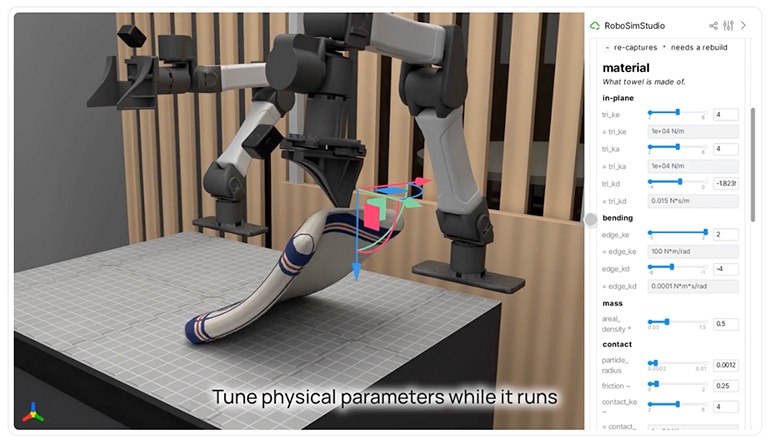
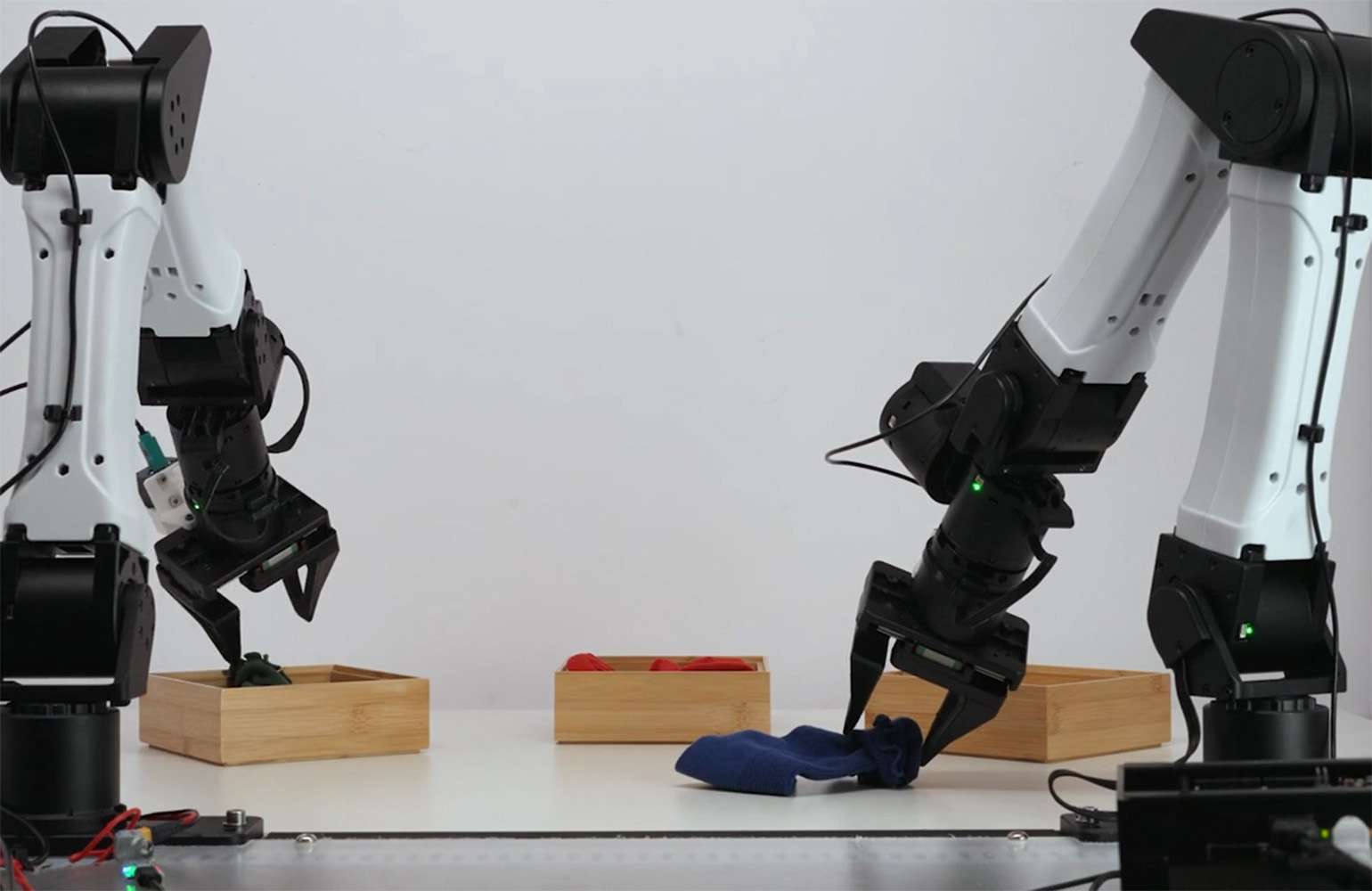
RoboSimStudio is another open-source project described in the report. It supports agentic AI coding of robotic simulation environments. The work was presented at CoRL 2026 in Austin, Texas, and is tied to the broader goal of using software agents not only to write robot logic but also to create and use the simulated scenes in which that logic can be tested.
According to Goldberg’s account, a graduate student provided GPT-6 Astra with a video and RoboSimStudio, and the model generated a Newton simulation within an hour. The reported example illustrates the research direction: translating a visual reference into a simulation that can support program development and evaluation.
Simulation cannot perfectly reproduce every physical detail of a factory floor. Real robots face calibration differences, sensor limitations, changing materials and unexpected interactions. Still, the ability to create and exercise a candidate program before a complete workcell is installed could give software teams more time to find issues and refine behavior.
Why the release matters
The significance of the Berkeley and NVIDIA release is less about a single robot task than about a proposed development workflow. It combines code generation, multi-agent coordination, simulation and human-readable outputs in an attempt to make industrial automation faster to build and easier to maintain.
The tools are open source, which gives other researchers and engineering teams an opportunity to test the approach against their own environments and constraints. The crucial next question will be how well these systems perform when simulations meet real equipment, production requirements and safety review.
For now, the work offers a concrete alternative to the traditional sequence in which robot software waits for most of the physical cell to be finished. If agentic systems can reliably generate programs that engineers can inspect and improve, they may help move more automation work to an earlier, more iterative stage of industrial design.
This article is based on reporting by The Robot Report. Read the original article.
Originally published on therobotreport.com