Closing the Sim-to-Real Gap
ABB Robotics announced a major integration of NVIDIA's Omniverse platform into its RobotStudio software, aiming to dramatically reduce the gap between simulated and real-world robot performance. The new capability, branded RobotStudio HyperReality, will launch as a subscription service in the second half of 2026.
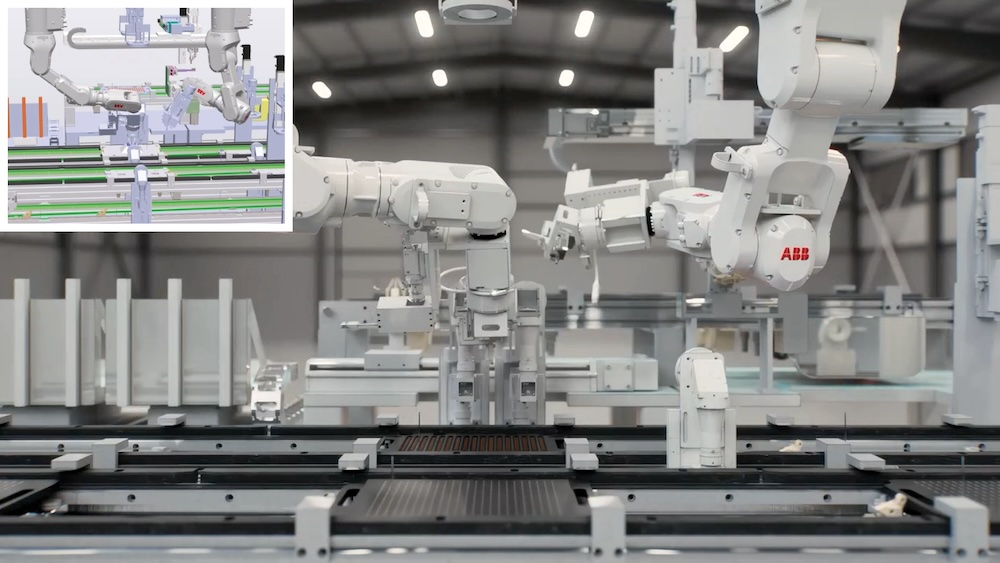
The integration allows robotics engineers to export complete robot cell configurations — including robots, sensors, parts, and lighting — into Omniverse environments for physics-based simulation and photorealistic rendering. ABB says its Absolute Accuracy calibration technology combined with Omniverse simulation can reduce robot positioning errors to approximately 0.5 millimeters in calibrated systems.
"RobotStudio HyperReality makes industrial-grade physical AI ready for real-world deployment at scale," said Marc Segura, president of ABB Robotics. The company claims the platform can cut setup times by up to 80 percent, reduce costs by 40 percent, and speed time-to-market by around 50 percent for complex automation products.
Why This Matters for Manufacturing
RobotStudio is already one of the most widely used robot programming environments in industry, with more than 60,000 robotics engineers using it to design robot cells, program robots offline, and simulate production processes. The addition of Omniverse's physics engine and rendering capabilities addresses one of the persistent challenges in industrial robotics: the gap between how a robot behaves in simulation and how it performs in the real world.
This sim-to-real gap has historically been a major bottleneck in robot deployment. Engineers often spend weeks or months fine-tuning robot programs after installation because simulated behavior does not perfectly match physical reality. Factors like gravity, friction, sensor noise, and mechanical tolerances all introduce discrepancies that can be difficult to predict.
By incorporating NVIDIA's physics simulation engine, ABB is betting that higher-fidelity simulation will shrink these discrepancies enough to allow engineers to deploy robots with minimal on-site adjustment. The approach aligns with a broader industry trend toward digital twins — virtual replicas of physical systems that can be tested and optimized before any hardware is installed.
The NVIDIA Omniverse Ecosystem
For NVIDIA, the ABB partnership extends Omniverse's reach deeper into industrial manufacturing. Omniverse was originally developed as a platform for collaborative 3D design and simulation, built on Universal Scene Description (OpenUSD), the open standard originally developed by Pixar for describing 3D scenes.
NVIDIA has been systematically expanding Omniverse's industrial applications, partnering with companies across automotive, logistics, and manufacturing. The ABB integration is notable because it brings physics-based simulation directly into an existing, widely adopted robot programming workflow rather than requiring engineers to adopt an entirely new tool.
The partnership also supports training AI models for robotic applications using synthetic data generated in Omniverse environments. This approach allows developers to train perception and manipulation models on millions of simulated scenarios rather than collecting expensive real-world training data.
Small and Mid-Size Manufacturers in Focus
Both companies emphasized that improved simulation and AI training workflows could make automation more practical for small and mid-sized manufacturers. These businesses often lack the engineering resources to handle complex robot deployments, and the high cost of integration has historically limited automation adoption outside large enterprises.
If RobotStudio HyperReality delivers on its promise of dramatically faster setup and deployment, it could lower the barrier for smaller manufacturers to implement robotic automation. The subscription model also reduces upfront costs compared to traditional perpetual software licenses, making the technology accessible to companies that might not justify a large capital expenditure.
The timing is significant given ongoing labor shortages in manufacturing across North America and Europe. Companies that have struggled to fill positions on production lines are increasingly looking to automation as a necessity rather than a luxury, creating demand for deployment tools that can compress timelines and reduce the need for specialized robotics expertise.
Competitive Landscape
ABB is not the only robotics company pursuing higher-fidelity simulation. Siemens, Fanuc, and Universal Robots have all made investments in digital twin technology and simulation-based deployment. However, the direct integration of NVIDIA's Omniverse platform gives ABB access to one of the most advanced physics simulation engines available, potentially offering a significant technical advantage.
The RobotStudio HyperReality launch will be closely watched by the manufacturing sector as a test case for whether improved simulation can truly deliver on the promise of faster, cheaper robot deployment at scale.
This article is based on reporting by The Robot Report. Read the original article.
Originally published on therobotreport.com