Satellite images captured a dramatic change on Oahu
NASA Earth Observatory has published a stark before-and-after view of flooding on Oahu following two powerful March storms that brought some of Hawaii’s worst flooding in decades. The imagery, acquired by the Operational Land Imager on Landsat 9, compares conditions on January 25, 2026, with those on March 14, 2026, after the first and more destructive of the two storm systems struck the island.
In the earlier image, coastal towns and green farmland between Mokuleia and Waialua appear largely unaffected, and the nearby ocean is mostly blue. In the later scene, floodwaters spread across neighborhoods and farmland, while a red-brown sediment plume extends into coastal waters around Kaiaka Bay. The side-by-side contrast makes the scale of the flooding legible in a way that rainfall totals alone often do not.
NASA says the flooding followed back-to-back low-pressure systems that struck Hawaii in March 2026. Near the islands, these subtropical weather systems are known as kona lows.
What made the storms so destructive
According to NASA Earth Observatory, the kona lows siphoned moisture from the tropics and fueled slow-moving thunderstorms with torrential, destructive rains. That combination is important. Storms do not need to move quickly to be dangerous; in many flood events, persistence is the key variable. When heavy rain lingers over the same areas, runoff accumulates, drainage systems are overwhelmed, and floodwaters spread far beyond streams and channels.
The National Weather Service reported rainfall totals of 5 to 10 inches across the state between March 11 and March 15. Some areas saw more than 30 inches. Weather stations in Honolulu, Hilo, Lihue, and Kahului all broke daily rainfall records during the period.
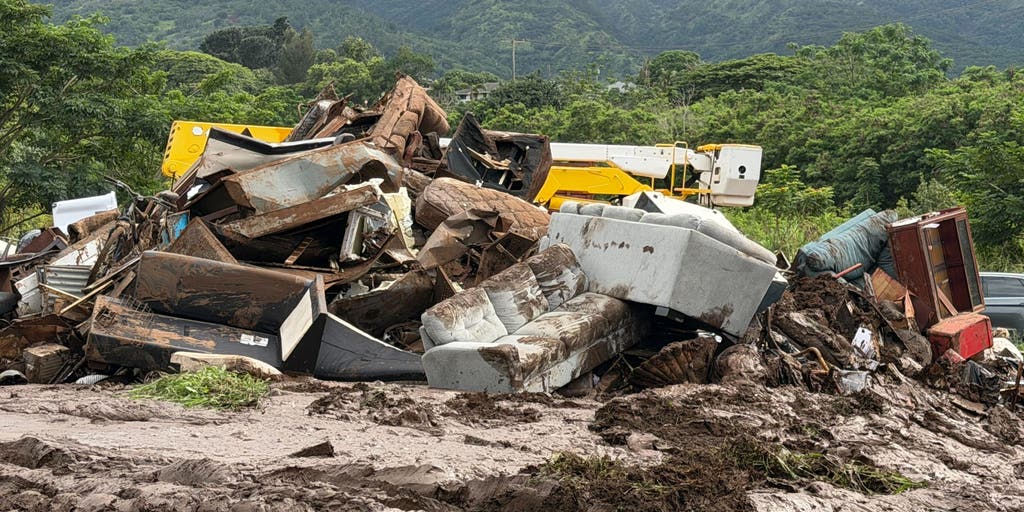
Those figures help explain why the flood signal in the satellite image is so extensive. The March 14 image does not show an isolated patch of standing water. It shows a landscape reorganized by runoff, with swamped neighborhoods, inundated farmland, and visible discoloration of nearshore waters from suspended sediment.
The view from space reveals more than flooded land
The most striking detail in the March 14 imagery may be the plume spreading into the ocean. NASA notes that suspended sediment discolored waters in and around Kaiaka Bay. That coastal signal matters because major flood events are not only terrestrial disasters. They also push soil, debris, and other material downstream and outward, altering water quality and visibly reshaping the coastal edge.
The image therefore documents several connected consequences of the storms at once. It shows floodwater pooling on land, disruption to agricultural areas, and sediment entering the marine environment. Even in a short article, the imagery conveys how a severe rain event propagates across systems rather than staying confined to a single map layer.
It also highlights the value of satellite observation after disasters. Ground reports can tell residents where roads are closed or how much rain has fallen, but orbital imagery can show the wider footprint of an event across neighborhoods, farmland, river mouths, and coastlines in one frame.
Why kona lows demand attention
The NASA summary places the March flooding in the context of Hawaii’s regional weather patterns. Kona lows are not generic storms; they are a class of subtropical low-pressure system associated with the islands. In this case, two of them arrived in close succession, compounding impacts over a short period.
Back-to-back systems are especially dangerous because the first storm can saturate soils and fill waterways, leaving the second storm to generate even faster runoff and broader inundation. NASA’s description does not need to state that in technical language for the pattern to be clear. The article explicitly says the first storm was the more destructive one on Oahu, and the overall sequence produced flooding severe enough to rank among the state’s worst in decades.
That phrasing also signals why the March event stands out beyond a single day of bad weather. Hawaii sees heavy rain, but NASA’s characterization suggests this episode crossed into a more exceptional category, both in accumulated rainfall and in observable surface impact.
A documented timeline from January to March
The date pairing in the imagery adds precision to the story. January 25 serves as the baseline: no floodwater is apparent, farmland remains intact in appearance, and the coastal ocean shows no major sediment plume. By March 14, the same area looks markedly transformed. That time window allows the reader to understand the flooding not as an abstract condition but as a documented change over less than two months, tied directly to the March storm sequence.
This is one reason Earth-observing missions matter during natural disasters. Satellites can establish reference conditions before a crisis and then provide post-event evidence of what changed. In this case, the comparison is visually straightforward and scientifically useful. It shows where floodwaters pooled, which areas were visibly affected, and how terrestrial runoff reached the shoreline.
NASA credits the imagery to Landsat 9, one of the agency’s long-running Earth observation tools. The article does not turn that into a technical discussion, but the implication is clear: repeated, consistent imaging makes it possible to monitor disasters over time rather than only react to them after the fact.
What this event says about hazard monitoring
The Oahu flood imagery is also a reminder that hazard assessment increasingly depends on combining weather reporting with remote sensing. The National Weather Service quantified the rainfall. NASA imagery showed the resulting footprint on the ground and along the coast. Together, those forms of observation provide a fuller picture of what happened than either could alone.
For residents, emergency managers, and researchers, that kind of combined view matters. Rainfall totals tell part of the story, but the public also needs to know where water spread, what land uses were affected, and whether coastal waters were altered by runoff. The March 14 scene answers those questions visually.
NASA’s account remains narrowly focused on the observed impacts and does not speculate beyond them. That restraint is useful. The story does not need embellishment. The facts are already substantial: back-to-back kona lows, 5 to 10 inches of rain statewide with some areas exceeding 30 inches, daily rainfall records broken at multiple stations, and satellite evidence of flooding severe enough to stand among Hawaii’s worst in decades.
The result is one of the clearest space-based snapshots yet of how extreme rainfall rapidly reshapes land and sea around the Hawaiian Islands.
This article is based on reporting by science.nasa.gov. Read the original article.