Indonesia moves from solar ambition to execution
Indonesia’s plan to deploy 100 gigawatts of solar power is no longer being framed only as a distant target. New research from the Institute for Essential Services Reform, prepared in collaboration with Indonesia’s Coordinating Ministry for Economic Affairs, lays out a 180-day action plan designed to turn the country’s directive into an implementation program.
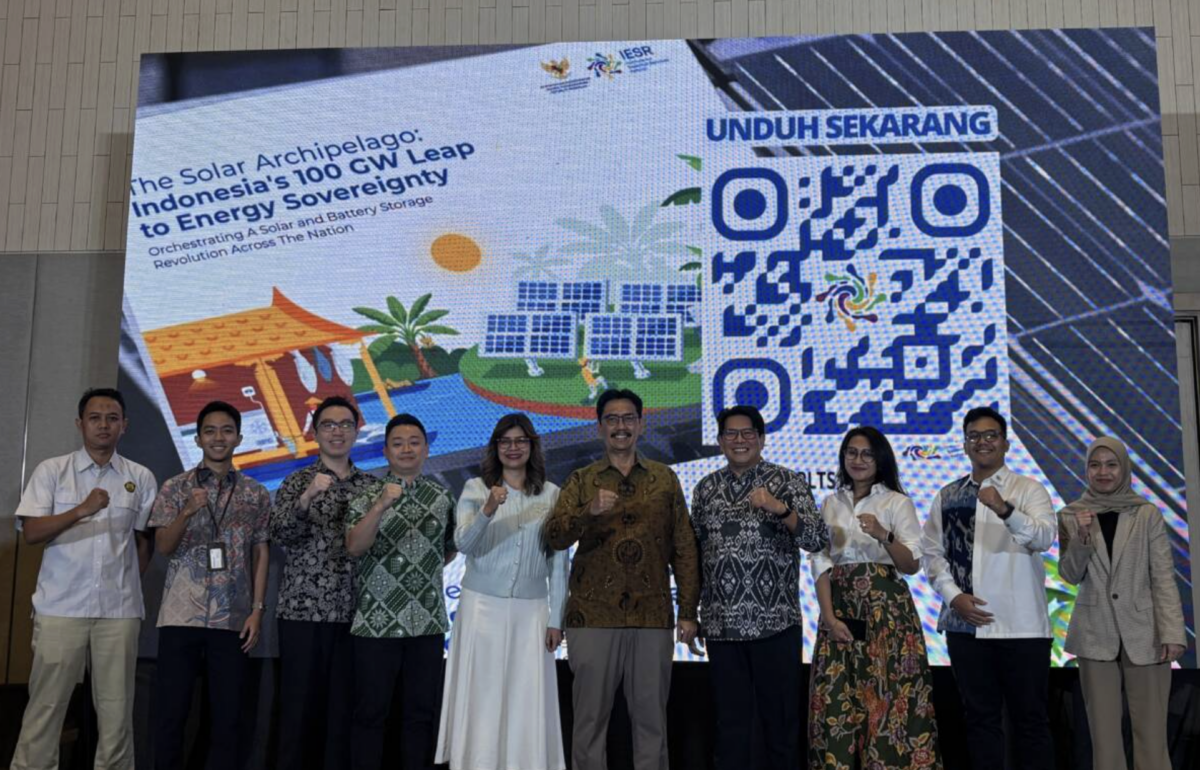
The report, titled The Solar Archipelago: Indonesia's 100 GW Leap to Energy Sovereignty, is positioned as a framework for operationalizing one of the region’s largest solar ambitions. The target itself was first announced in August 2025. What is new here is the attempt to convert a political signal into an administrative and delivery sequence.
That matters because the scale is unusually large and the structure is unusually broad. Indonesia’s 100 GW goal is split into 80 GW of decentralized, small-scale solar systems paired with battery energy storage systems across 80,000 villages, along with 20 GW of centralized solar deployment. In other words, the initiative is not only about utility-scale generation. It is also about rural electrification, distributed infrastructure, and the logistics of building a national solar buildout across an archipelago.
A solar strategy shaped by geography
Indonesia’s geography makes centralized energy planning harder than it is in more compact countries. A strategy built around thousands of islands and tens of thousands of villages necessarily requires a different deployment logic. The report’s emphasis on decentralized systems reflects that reality. Small-scale solar with storage can be deployed closer to where demand exists, reducing reliance on transmission-heavy expansion and creating a pathway for communities that may otherwise wait much longer for conventional infrastructure.
The 20 GW centralized component remains significant. Large projects can still provide scale, drive procurement volumes, and help anchor national generation capacity. But the 80 GW distributed portion is the more distinctive element. It suggests that Indonesia’s solar buildout is being conceived not just as an energy transition project, but as a nationwide development platform.
Why the first 180 days matter
Large public targets often fail not because of a lack of ambition, but because no one defines the first institutional moves with enough precision. The value of a 180-day plan is that it forces attention onto sequencing. Before hardware arrives, governments need governance, project pipelines, program ownership, and procurement rules that can survive scale.
That is where the report appears to focus its weight. According to pv magazine’s account of the findings, IESR is recommending that the initiative be designated as a national strategic program. It is also recommending the establishment of a centralized project management unit. Those are not minor bureaucratic details. They are a recognition that a 100 GW target cannot be managed as a loose collection of regional efforts.
A national strategic designation would signal priority across ministries and agencies. A centralized project management unit would create a home for coordination, tracking, and problem solving. For a program spanning village systems, batteries, centralized plants, and multiple levels of government, coordination is likely to be as decisive as financing or module supply.
From mandate to mobilization
The report’s framing is especially notable because it describes the challenge as moving from mandate to mobilization. That wording captures a common gap in energy policy. Governments can announce capacity goals. Markets can welcome them. But without a practical mechanism for turning targets into approved projects, financed installations, and completed systems, the gap between headline and reality widens quickly.
Indonesia’s case is also shaped by timing. Solar costs, storage adoption, and energy security concerns have combined to make large-scale solar planning more urgent across Asia. For Indonesia, a country with substantial energy demand growth and a dispersed population, the idea of pairing solar with storage at village level has both political and practical appeal.
If the recommendations are adopted, the next test will be whether the program develops consistent delivery structures rather than one-off announcements. A target of 80,000 village deployments requires repeatable processes, not bespoke execution. Standardized designs, clear procurement pathways, and accountable milestones will likely matter more than a single flagship project.
The bigger signal
The broader significance of the new framework is that it treats solar not as a side program, but as a core national system. The combination of decentralized village systems, batteries, and centralized capacity points to a layered energy architecture rather than a one-track approach.
That could prove important beyond Indonesia. Many emerging markets face the same dilemma: how to scale renewable generation quickly while also extending practical energy access. Indonesia’s proposed mix offers one answer. It does not reject large projects, but it does not assume they are enough.
The next 180 days will not determine whether Indonesia reaches 100 GW on their own. They will, however, show whether the target is being organized as a real national buildout or left as an aspirational figure. The difference between those two outcomes usually comes down to institutional design. This report is an attempt to supply it.
This article is based on reporting by PV Magazine. Read the original article.
Originally published on pv-magazine.com




