A strange behavior points back to human visitors
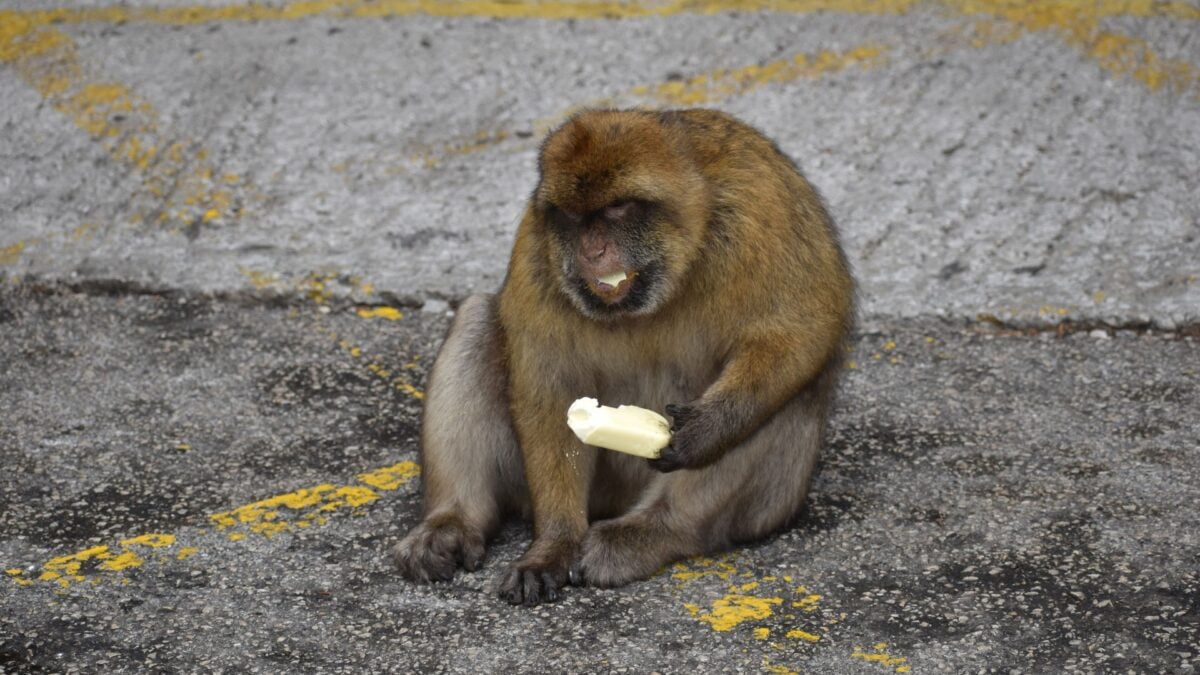
Researchers studying Gibraltar’s Barbary macaques say they have identified a likely reason some of the animals are regularly eating dirt: tourists. A report on the findings says macaques living closest to heavily visited areas are the most likely to consume soil, a behavior known as geophagy. The pattern suggests the animals may be using dirt to calm stomach upset after eating junk food obtained from people.
That explanation fits both the field observations and Gibraltar’s unusual ecology. The British territory at the southern tip of the Iberian Peninsula is home to Europe’s only wild monkeys, with an estimated population of about 200 to 300 Barbary macaques. Although local authorities provide fruits and vegetables, the animals also get food from tourists, whether offered directly or taken opportunistically.
Over time, that has created a semi-human food environment around parts of the Rock of Gibraltar. The new observations indicate that the monkeys are not just taking advantage of that environment. They may also be adapting behaviorally to its digestive consequences.
How the pattern was discovered
The behavior emerged during the Gibraltar Macaques Project, a long-term study launched in 2022 by University of Cambridge biological anthropologist Sylvain Lemoine. Researchers noticed that dirt eating appeared to be common in some groups and absent in others, even though it had not previously been formally reported or studied in the population.
Once the team began systematically recording the behavior, the differences between groups became clearer. Geophagy was most common in troops spending the most time in tourist-friendly areas, including near the top of the Rock. The researchers also observed monkeys eating soil immediately after consuming food from tourists on multiple occasions.
The contrast with less human-exposed groups strengthened the interpretation. Monkeys with less contact with people ate less dirt, while one troop with no prolonged human interaction showed no geophagy at all. That gradient is the key evidence in the story: the closer the animals are to tourist pressure and human food, the more likely they are to show the soil-eating behavior.

Why dirt might help
The proposed explanation is that soil may help soothe digestive problems caused by an unnatural diet. The report says researchers considered and rejected other possible explanations, including mineral cravings linked to pregnancy. Instead, the observations pointed back to stomach discomfort after tourist feeding.
Geophagy is not unknown in the animal world, and in some contexts it is thought to buffer toxins or calm the digestive tract. In Gibraltar, the behavior appears to be part of a local adaptive strategy. If the monkeys are eating richer, saltier or more processed foods than their regular diet would provide, soil consumption may be one of the ways they cope with that disruption.
This is what makes the finding more than a curiosity. It is not just that the macaques do something odd. It is that a human-created food environment may be reshaping their behavior in a compensatory way.
A case study in human-wildlife entanglement
The Gibraltar macaques live in a landscape where wildlife management, tourism and public fascination are tightly entangled. People are drawn to the monkeys precisely because they feel accessible and charismatic. That attention brings food, interaction and a constant pressure on behavior.
The new findings add to the evidence that animals living in close contact with humans can become highly responsive to those pressures, not only in obvious ways such as scavenging or boldness, but also in subtler physiological and behavioral adjustments. In this case, the adaptation may be visible in something as simple as where and when a monkey eats dirt.
Lemoine described the work as shedding light on the adaptability of primates living in highly anthropogenic landscapes. That is a precise way of saying these are not untouched wild populations. They are animals navigating a habitat heavily shaped by humans, human food and human attention.

Why the findings support stricter feeding rules
The report says the results support existing rules against feeding the monkeys. That conclusion follows naturally from the observed link: if tourist food is associated with digestive stress and compensatory soil eating, then limiting human feeding is not just about discouraging nuisance behavior. It is also a matter of animal health.
This is often the hidden problem in tourist-wildlife encounters. Feeding can seem harmless or even affectionate from a visitor’s perspective. But once repeated across large numbers of people, it can distort diet, social dynamics and risk exposure for an entire population. The macaques’ dirt eating may be one visible symptom of a broader imbalance.
There is also a public-facing lesson here. Human influence on wildlife is not always dramatic enough to show up as population collapse or habitat destruction. Sometimes it appears as a behavioral workaround, an animal-level adjustment to a new and unstable reality. Those changes can be easy to miss until researchers document them systematically.
A small but revealing discovery
The Gibraltar study does not claim that tourists alone define macaque life, but it does show how tightly their behavior can be linked to human presence. A troop with minimal exposure behaves differently from troops embedded in visitor-heavy spaces. That difference is exactly what makes the finding credible and useful.
In practical terms, it gives wildlife managers more evidence to support controls on feeding and visitor interaction. In scientific terms, it offers a vivid example of how primates adapt to anthropogenic environments. And in cultural terms, it exposes the downside of a familiar tourist fantasy: that feeding charismatic animals is a benign way to connect with nature.
The monkeys of Gibraltar are proving adaptable. But adaptability should not be mistaken for a lack of cost. If they are eating dirt to settle the effects of human snacks, then the animals are telling a story about coexistence that is less charming than the tourist brochures make it look.
This article is based on reporting by Gizmodo. Read the original article.
Originally published on gizmodo.com