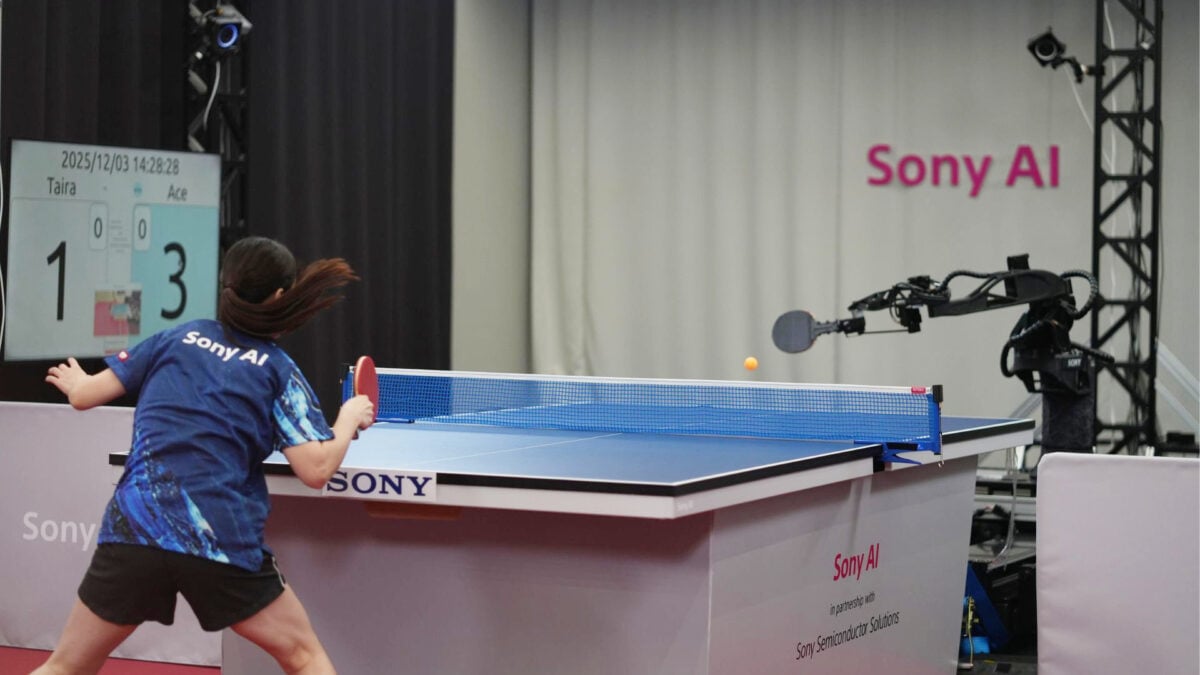
Sony’s Ace Robot Takes On Elite Human Players
Sony AI researchers have developed an autonomous table tennis robot called Ace that can compete with highly skilled human players under formal rules, according to a Gizmodo report on a newly published study. The system won three of five matches against elite players, though it lost both matches against professional athletes Minami Ando and Kakeru Sone.
The study matters because table tennis is a demanding test for physical AI. A robot has to perceive the ball, estimate its trajectory from imperfect sensor data, move quickly, return high-speed and high-spin shots, and adapt to an opponent in real time. That is different from software-only AI systems that operate in simulated or fully digital environments.
A Hard Test For Human-Robot Interaction
Lead author Peter Durr told Gizmodo that Ace demonstrates the potential of physical AI agents to perform complex, real-time interactive tasks. The source text notes that the researchers used International Table Tennis Federation rules and licensed umpires, giving the evaluation more structure than a lab-only demonstration.
The robot faced five elite players defined as people with at least 10 years of playing experience who regularly trained about 20 hours a week on average. Ace also played two professionals active in Japan’s professional table tennis league. It won a game against a professional player but did not win either professional match.
- Ace won three of five matches against elite nonprofessional players.
- The robot lost both matches against professional players.
- The study used ITTF rules and licensed umpires.
- The system consistently served and returned high-speed, high-spin balls, according to the source text.
The broader significance is not that robots are about to dominate sport. It is that fast, precise, adaptive physical interaction is becoming more capable. Systems like Ace could inform future robotics in settings where timing, perception, and safe interaction with people are essential.
This article is based on reporting by Gizmodo. Read the original article.
Originally published on gizmodo.com