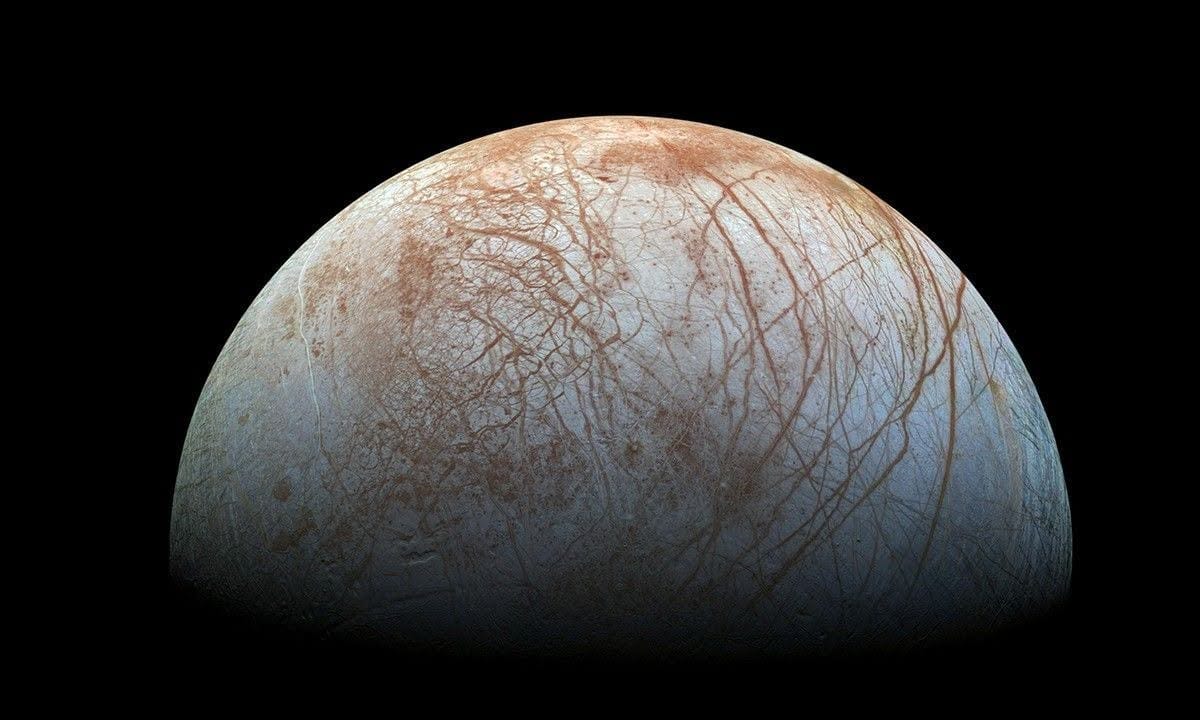
A familiar target in the search for alien life may complicate that search
Europa has long been treated as one of the most promising places in the Solar System to look for life. The icy Jovian moon is thought to hold a vast subsurface ocean beneath its frozen shell, making it a natural focus for astrobiology. A new study, however, raises a more complicated possibility: if life is eventually found there, some of it could be descended not from an independent Europan origin, but from Earth.
The study, by Zaza Osmanov of the Free University of Tbilisi and published in the International Journal of Astrobiology, examines whether dust particles containing living bacteria ejected from Earth could reach Europa and land on its surface. The paper concludes that the scenario is “highly plausible” in the broad statistical sense, because Earth has likely been shedding life-bearing particles into surrounding space for billions of years.
That idea belongs to the larger concept of panspermia, the notion that life can travel between worlds. Scientists have long considered versions of that hypothesis, including the possibility that life on Earth itself might have been seeded from elsewhere. What makes the new study striking is its attempt to model the pathway in the opposite direction, from Earth outward to one of the Solar System’s most compelling ocean worlds.
How Earth microbes might reach Europa
According to the study summary, Osmanov estimated the rate at which dust-borne bacteria could be dislodged from Earth by impacts, survive a long journey through space, and endure impact on Europa’s surface. His conclusion is that many trillions of life-bearing dust grains from Earth could have reached Europa over tens of millions of years.
That does not mean Europa is likely teeming with transplanted terrestrial microbes. The journey is harsh, the arrival conditions are harsh, and the path from the surface to the moon’s buried ocean is harder still. But the study argues that the sheer number of particles involved may make the scenario plausible despite the unfavorable odds facing any individual microbe.
The paper goes a step further by considering what might happen after arrival. Surviving microbes on Europa’s surface, the study suggests, could in principle work their way downward through cracks in the moon’s ice shell over time and eventually reach the dark waters below. That is the most speculative part of the scenario, but it is also the part with the most direct implications for future life-detection missions.

Why the idea matters for astrobiology
The study does not claim that Earth life is on Europa today. It argues that the transport mechanism is plausible enough to take seriously. That matters because Europa is often framed as a place where discovering life would answer one of humanity’s biggest questions: whether biology emerged independently beyond Earth. If contamination by natural transfer is even remotely possible, that question becomes more nuanced.
A living microbe on Europa would still be a profound discovery. But the interpretation would change if researchers could not rule out a terrestrial ancestry. In that sense, the paper is not just about exotic biology. It is about scientific standards for interpreting one of the most important possible findings in space science.
The argument also sharpens concern around planetary protection, though in a natural rather than human-made form. Space agencies already worry about contaminating target worlds with Earth organisms carried on spacecraft. This study suggests nature may have been running its own contamination experiment for geological timescales. If so, distinguishing native life from migrants becomes even more difficult.
The challenge for future missions
Europa remains a compelling destination precisely because it combines habitability potential with accessible signs of internal activity at the surface. But that accessibility cuts both ways. A surface sample might be easier to obtain than an ocean sample, yet it might also be harder to interpret. Material on the surface could reflect external delivery, radiation processing, or only an indirect relationship to the underlying ocean.
The broader lesson is that finding biology is not the same as proving independent origin. Future missions to Europa will need to think carefully about biosignatures, context, and ancestry. Chemical complexity, isotopic ratios, and environmental placement may all matter if scientists hope to distinguish a Europan biosphere from one seeded, however improbably, by Earth.
Osmanov’s study does not settle the matter, and its conclusions will likely invite debate. But it performs an important service by expanding the question. The search for alien life often assumes a sharp boundary between Earth and elsewhere. This work suggests the boundary may be blurrier, at least over immense spans of time.
That possibility does not make Europa less interesting. If anything, it makes the moon more intellectually difficult and therefore more compelling. The discovery of life there would still transform science. It would simply force researchers to answer a second question immediately afterward: whose descendant is it?
This article is based on reporting by 404 Media. Read the original article.

Originally published on 404media.co