A major Canvas breach has turned a routine dependency into a systemic warning
A cyberattack affecting Canvas has thrown schools into disruption and revived a longstanding question about educational technology: what happens when one platform becomes the operational center of classroom life for millions of people?
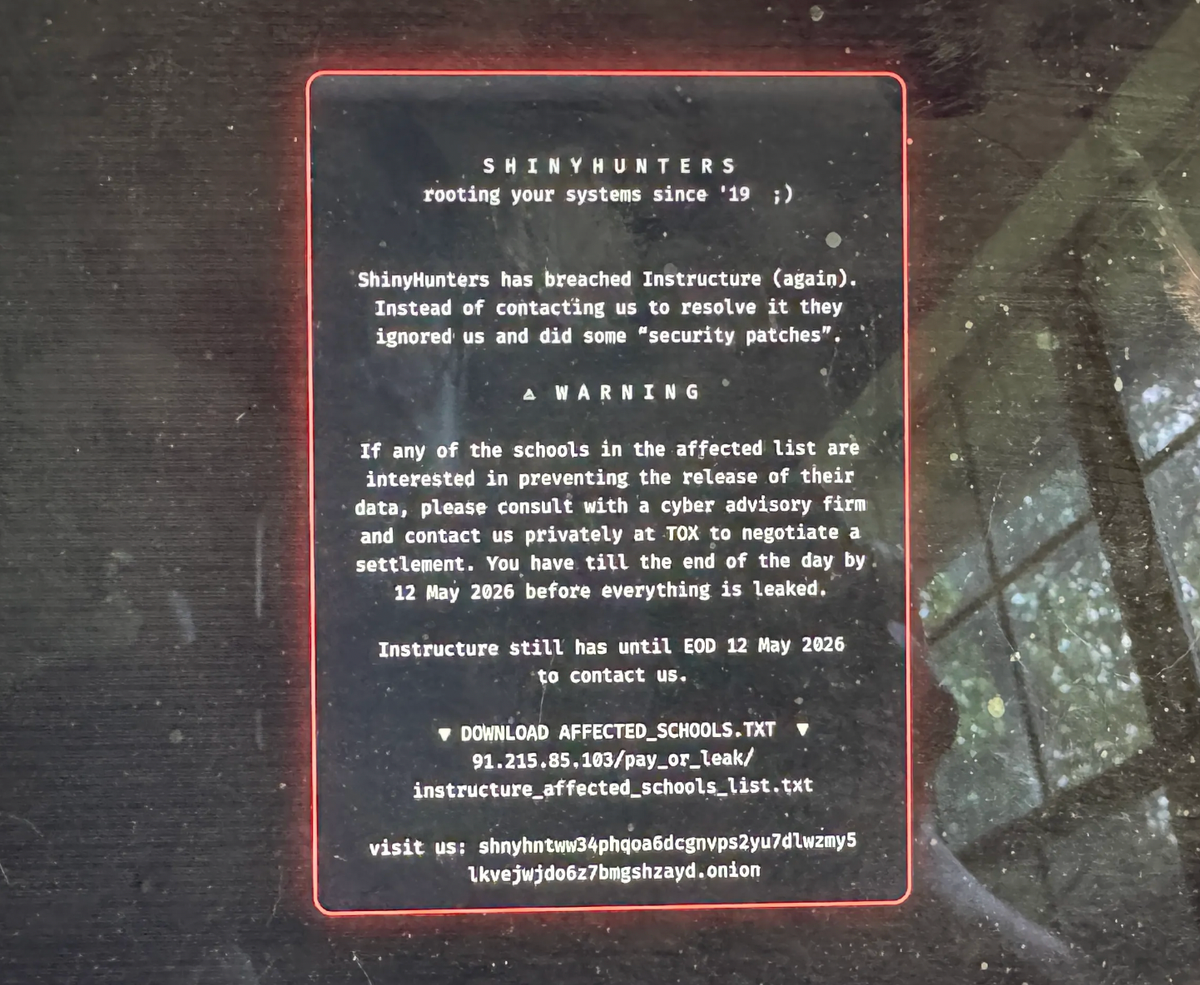
According to 404 Media, the ransomware group ShinyHunters hacked Canvas parent company Instructure, apparently stole vast amounts of data and briefly locked students out of the service on Thursday afternoon. The report says the attackers claimed to have stolen “billions” of messages and accessed data from more than 275 million individuals. Instructure later restored most of Canvas service, but the scale and sensitivity of the reported breach have made it one of the most consequential education technology incidents in recent memory.
Canvas is not a peripheral app for many institutions. It is where teachers post assignments and lectures, where students communicate with instructors and classmates, where discussion boards live and where other education tools are often linked together. When that hub fails, the disruption is not limited to inconvenience. It can affect communication, grading, coursework and even decisions about whether exams can proceed.
What the company and outside experts said was exposed
Instructure noted on an incident update page, according to the report, that stolen data includes certain personal information of users at affected organizations. That includes names, email addresses, student ID numbers and messages among Canvas users. The company also said it had been breached twice, once on April 29 and again on Thursday.
The scope of the messages is especially troubling because school platforms often carry far more than administrative chatter. They can contain private academic discussions, disciplinary disputes, accessibility-related communication, medical circumstances and other highly sensitive exchanges. The 404 Media report framed the incident as demonstrating the danger of concentrating educational and personal data inside a single service used across thousands of institutions.
That concern was reinforced by Ian Linkletter, a digital librarian who specializes in emerging education technology. Linkletter, who has worked in EdTech for 20 years, told 404 Media that the Canvas hack is “the biggest student data privacy disaster in history.” While that is his characterization rather than an official designation, it reflects the extraordinary combination of scale, sensitivity and institutional dependence involved in the breach.
Why the outage mattered immediately
The operational effect was visible almost at once. The report says that at about 1:20 p.m. Pacific time on Thursday, people began posting screenshots of the breach message to Reddit. Schools moved quickly into response mode, with some institutions urging users to change passwords if they were logged in. According to Linkletter’s account in the report, senior administrators at schools were already meeting to discuss whether finals might need to be canceled the following week.
That reaction underscores how deeply Canvas is embedded in academic infrastructure. The platform is not just a digital filing cabinet. At many schools it is the backbone for teaching, assessment and student communication. When the service is compromised, the problem spills into every layer of academic operations because institutions have organized so much of their daily activity around one vendor-controlled system.
Centralization can produce efficiencies. It can also create single points of failure. The Canvas incident shows the tradeoff starkly. A shared platform simplifies workflow and adoption across schools, but it also means a single breach can cascade across universities, colleges and K-12 systems at once.
The larger lesson for EdTech
The breach arrives in a sector that has often expanded faster than its public scrutiny. Education technology tools routinely handle minors’ information, academic records, private communication and institutional data under conditions that many students and families do not fully understand. The more functions those platforms consolidate, the larger the consequences when security fails.
In this case, the risk is not abstract. The reported theft involves both identifying information and messages, two categories that can be especially harmful when combined. Names and student IDs can support fraud or impersonation. Messages can expose intimate details of student life and school processes. Even the temporary loss of access can disrupt coursework, deadlines and exam planning at scale.
The incident also raises governance questions for schools. If a learning management system becomes the de facto operating system of education, then procurement decisions are no longer just about convenience, features or pricing. They are also about breach impact, data minimization, redundancy and institutional resilience. A platform that touches nearly every aspect of schooling requires security expectations closer to critical infrastructure than to optional software.
What institutions now have to confront
Schools using Canvas will likely focus first on incident response: account security, communication with students and staff, and assessment of what data may have been exposed. But the broader issue is structural. Institutions have spent years consolidating communication, grading, assignments and integrations into centralized platforms because the model is efficient and manageable. The Canvas attack shows how that convenience can convert into concentrated risk.
Whether or not the full claims made by the attackers are independently confirmed later, the event has already become a test case for how much data educational platforms should be allowed to collect and retain in one place. It also highlights how little room many schools have to operate when a core system fails unexpectedly.
Canvas was mostly brought back online, according to the report, but that restoration does not close the larger debate. If anything, it intensifies it. The attack exposed not only data but dependency. For millions of students and educators, that may prove to be the more enduring lesson.
- 404 Media reported that ShinyHunters hacked Instructure, the parent company of Canvas.
- Instructure said exposed data included names, email addresses, student ID numbers and user messages.
- The breach has renewed concerns about concentrating educational records and communication inside one platform.
This article is based on reporting by 404 Media. Read the original article.
Originally published on 404media.co