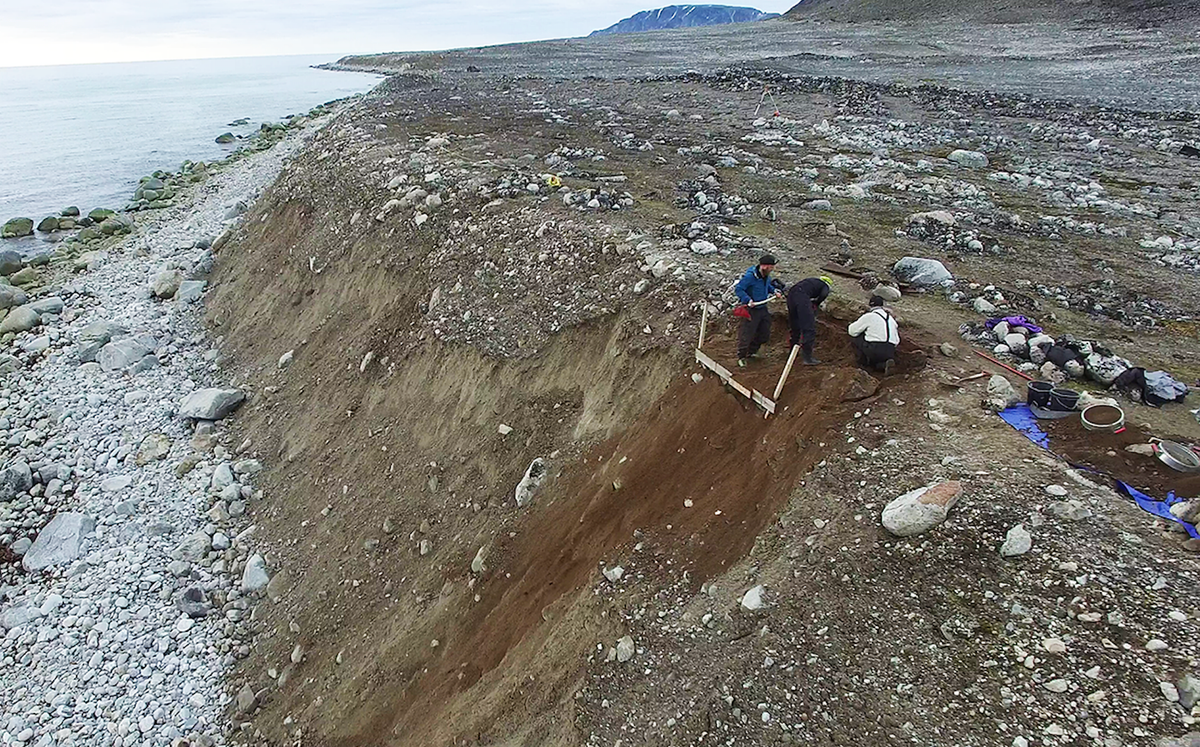
Permafrost loss is exposing the dead in Svalbard
Centuries-old graves at the Likneset whaling burial site in Norway’s Svalbard archipelago, also known as “Corpse Point,” are degrading as Arctic permafrost thaws, according to a new study highlighted by 404 Media. The research, published in PLOS One by Lise Loktu and Elin Therese Brødholt, describes how the remains of European whalers buried there in the 17th and 18th centuries are being disturbed as warming conditions undermine the ground that preserved them for generations.
The study’s significance goes well beyond one burial site. It turns climate change into a visible problem of heritage loss, where rising temperatures do not just threaten future landscapes but actively erase the physical record of the past. At Likneset, that erosion is immediate and human. Coffins are collapsing, sideboards are shifting, and skeletal remains and textiles are being disturbed.
A rare long-term view of deterioration
The researchers note that the site has been excavated repeatedly over more than three decades, creating an unusual opportunity to measure changes in preservation over time. That repeated documentation matters. Many archaeological sites are known to be vulnerable, but fewer have a record detailed enough to show how quickly conditions are worsening within the same cemetery and across contrasting burial environments.
According to the supplied source text, the team found significant degradation in many burials since the site was first documented in the 1970s. One grave, identified as Grave 214, was classified as completely destroyed. The article also cites the researchers’ observation that in several cases coffin lids had collapsed and sideboards had been displaced, leading to partial disturbance of skeletal remains and textiles.
Those specifics are what shift the story from abstract warning to documented loss. This is not simply a projection about what a warmer Arctic may do one day. It is an account of damage that has already occurred and is visible in the archaeological record.

The Arctic is amplifying the problem
404 Media’s summary emphasizes that the Arctic is warming nearly four times faster than the global average. In that context, Svalbard is not just another endangered heritage zone. It is part of a region where climate-driven change is compressed into a shorter and more intense timeline. Materials once stabilized by cold ground conditions can become newly vulnerable to collapse, erosion, microbial activity, and physical disturbance as permafrost changes.
The Likneset site therefore functions as both a local emergency and a wider warning. What happens there illustrates how quickly a preservation environment can deteriorate when the climate assumptions that protected it no longer hold. For archaeologists and cultural heritage managers, that means the timeline for response may be much shorter than older conservation models assumed.
The site also preserves a record of work and hardship
The men buried at Likneset were whalers, and the study, as summarized in the candidate text, says their remains reveal the physical toll of whaling on sailors. That adds another layer to the urgency. The site is not only a collection of graves; it is also evidence of labor, injury, risk, and the human cost of an early modern industry.
When such places degrade, the loss is double. There is the immediate destruction of material evidence, and there is the narrowing of what future researchers can learn about lives that were already underdocumented. Skeletal evidence, burial construction, and surviving textiles can all carry clues about health, work, status, environment, and burial practice. Once that context is disturbed or destroyed, recovery becomes difficult or impossible.

Climate change is damaging the past as well as the future
The report places Likneset within a broader pattern. It notes that climate change is threatening cultural remains across the world, including ancient artifacts preserved in Mongolian glaciers and very old rock art in Indonesia that is rapidly decaying. That comparative frame matters because it shows the issue is not confined to one type of site or one geography. Cold-preserved graves, glacial finds, and rock art all face different mechanisms of loss, but the common factor is environmental instability.
That perspective also changes how climate impacts are understood in public debate. Discussions often center on infrastructure, ecosystems, agriculture, or future risk. Heritage sites can be treated as secondary concerns. But the damage at “Corpse Point” shows that cultural memory is itself part of the climate story. Once gone, these materials cannot be rebuilt in any meaningful sense.
An urgent conservation problem
The supplied material points to an urgent need to preserve threatened cultural heritage as temperatures rise. Likneset illustrates why urgency is not rhetorical. Repeated excavation history allowed researchers to observe change over time, but observation alone does not stop loss. The site’s deterioration raises difficult questions about monitoring, intervention, worker safety, and the limits of preservation under accelerating warming.
For now, the central finding is stark: human-driven climate change is thawing the ground at a centuries-old Arctic burial site and disturbing the bodies buried there. That single fact carries scientific, historical, and ethical weight. It is a reminder that the warming world is not only changing what lies ahead. It is also destabilizing what has survived behind us.
This article is based on reporting by 404 Media. Read the original article.

Originally published on 404media.co