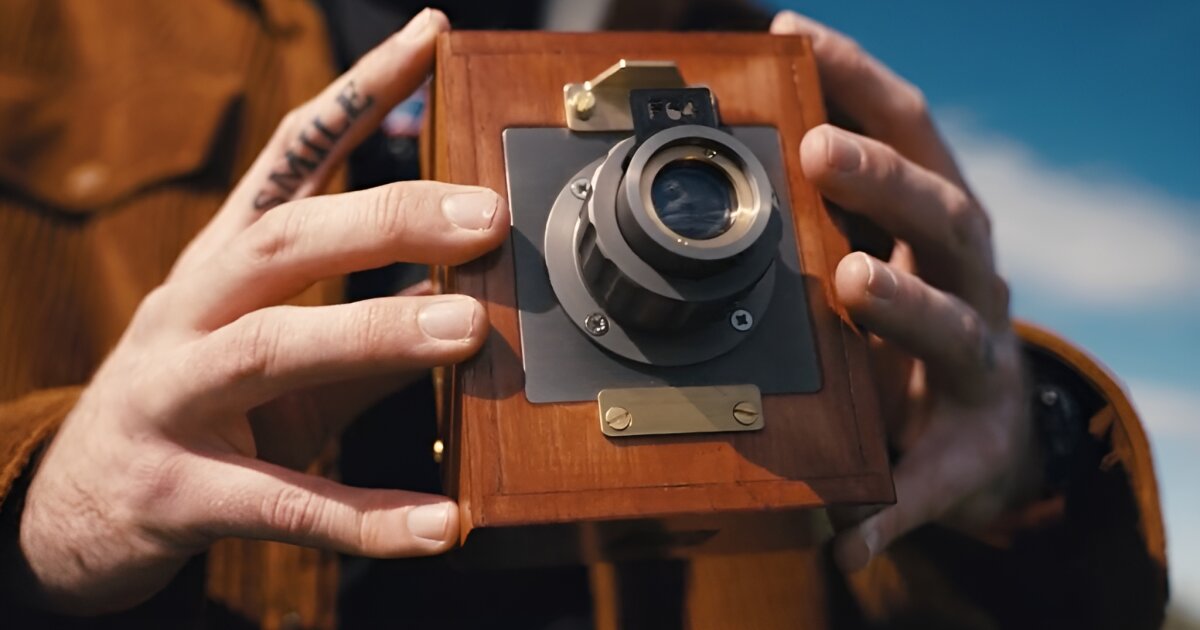
An old photographic idea returns in a compact handcrafted form
In a market dominated by instant digital capture, the Alfie BOXX is heading in the opposite direction. The retro-inspired wooden camera, created by British product designer Dave Faulkner, is built around a slower proposition: composing, exposing, and developing black-and-white prints inside the camera body itself.
The device is presented as a contemporary interpretation of early photography workflows, combining a handcrafted exterior with a field-ready developing process. According to its description, the BOXX can produce 6 x 9 cm black-and-white prints and complete the development inside the camera while the user is still out shooting. That makes it less a simple camera than a compact analog system for image-making and printmaking together.
Faulkner, whose earlier Alfie Tych half-frame camera was also aimed at enthusiasts of tactile photography, frames the BOXX as a way to put a “complete analogue experience” into a portable object. The camera is currently being offered through Kickstarter, underscoring both its niche appeal and the maker-led route often taken by specialized photographic hardware today.
Designed around manual craft rather than convenience
The BOXX is made from stained and lacquered hardwood, with brass attachments and a sprung back mechanism that uses a traditional ground-glass viewing screen. With a 100 mm lens attached, it measures 139 x 98 x 118 mm. The design choices are deliberate: the camera is meant to feel closer to 19th-century photographic equipment than to a modern consumer device, even while its portability and modularity make it more accessible than truly historical gear.
The camera supports an interchangeable modular lens system built around a 75 mm square lens board. Three lens options are described. The Wollaston is a 100 mm f/8 to f/32 portrait lens based on an 1812 design by William Hyde Wollaston and offers manual focus from 1 meter to infinity. The Steinheil Periscopic is a 55 mm f/16 wide-angle lens based on an 1865 design associated with folding cameras and focuses from 50 centimeters to infinity. The third option is a 65 mm f/190 pinhole lens with a magnetic shutter and preview aperture for a soft-focus camera obscura effect.
Those choices are notable because they do not merely change focal length. They also invite different historical image aesthetics, from portrait-style rendering to wide-angle compositions to experimental pinhole softness. In that sense, the BOXX is a platform for analog interpretation as much as a camera body.

The key differentiator is the in-camera processing workflow
The most unusual feature is the internal development process. Exposure is handled manually using the lens cap for the 55 mm and 100 mm lenses, because there is no conventional shutter for those optics. Once composition is complete, users attach a magnetic Pocket Darkroom film holder and proceed through a workflow intended to move directly from capture to print creation.
That matters because most contemporary analog photography revivals still separate image capture from chemical processing. Film may be loaded in the field, but development is usually delayed until later and handled elsewhere. The BOXX compresses those steps into a single object and a single session. It tries to recreate the sense that photography is not just about taking a shot, but about carrying a process from scene selection to physical image.
For enthusiasts, that could be the product’s real appeal. It is less about speed than about ownership of the entire act. Each image demands setup, focusing, manual exposure, and a physical processing ritual. The resulting print is not only a photograph but also evidence of the method used to make it.
Why products like this still attract attention
Analog photography has remained resilient because it offers something digital systems often minimize: visible process. Cameras like the BOXX go even further by making process the main event. They serve a community that is not looking for frictionless capture, but for intentionality, constraints, and material output.
The product also fits into a wider innovation pattern in consumer hardware. Some of the most interesting new devices are not mass-market attempts to outperform smartphones. Instead, they are specialized tools that intensify a specific experience, whether that means mechanical keyboards, modular synthesizers, or high-craft cameras. The BOXX belongs to that world. It is a small-batch object aimed at users who value design lineage, manual control, and a differentiated workflow over broad convenience.
There is also a cultural angle. By drawing on designs from 1812 and 1865 and invoking the spirit of street photographers who handled their own processing, the camera turns photographic history into a usable interface. It does not simply mimic an old form. It packages historical techniques into a contemporary portable artifact.
Its limitations are inseparable from its appeal
The same features that make the BOXX distinctive also narrow its audience. Manual focusing, lens-cap exposure, physical development, and black-and-white output mean it is not competing with mainstream cameras on speed, flexibility, or ease of use. Its Kickstarter status also places it in an earlier-stage product category, where enthusiasm and execution still need to meet.
But that limitation is part of the point. The BOXX is not trying to modernize analog photography by stripping away complexity. It is trying to make complexity portable, legible, and enjoyable. That is a more interesting proposition than simple nostalgia, because it treats old processes as active design material.
Whether it becomes a durable commercial product remains to be seen. What is clear from the concept is that even in an era of computational imaging and automated enhancement, there is still room for devices that slow image-making down and turn the camera back into a place where the picture is made, not just captured.
This article is based on reporting by New Atlas. Read the original article.
Originally published on newatlas.com