A startup is industrializing robot training
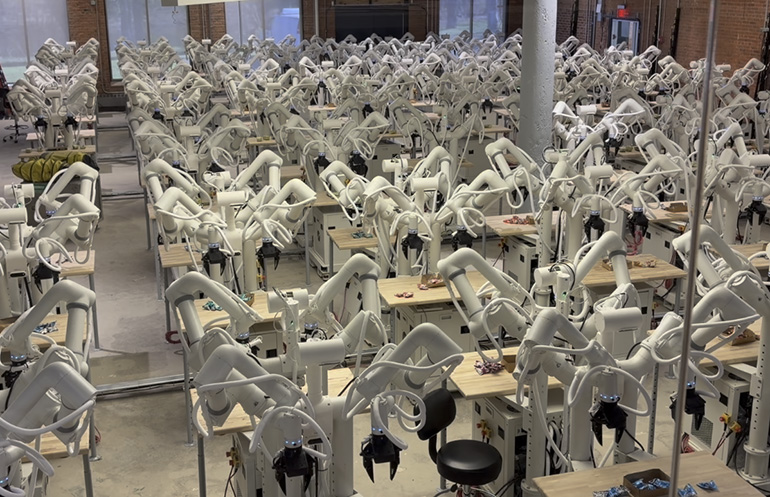
Tutor Intelligence is making an unusually direct argument about the future of robotics: the bottleneck is not only better models, but better data gathered from robots acting in the real world. To attack that problem, the company has built what it calls DF1, a “Data Factory” of 100 bimanual manipulators that it describes as a kind of kindergarten for physical AI.
The idea is simple in concept but ambitious in execution. Instead of relying primarily on simulation, Tutor is using real robots, human teleoperators, and repeated task performance to train its Ti0 vision-language-action model. The company says this setup can create the kind of grounded, scalable learning pipeline that robotics has lacked compared with the data abundance available to large language models.
That comparison is central to Tutor’s pitch. As co-founder and chief executive Josh Gruenstein put it, there is no robotic equivalent of Wikipedia. Human knowledge on the internet gave language models a vast corpus to learn from. Robots need something different: physical demonstrations, corrective feedback, and repeated exposure to the messiness of real objects and environments.
Why real-world data is strategically attractive
Tutor’s DF1 effort reflects a broader debate in robotics. Simulation remains valuable because it is cheap, fast, and safe. But transferring behaviors from simulation to reality often runs into the stubborn complexity of actual physical interaction. Objects deform, slip, reflect light unpredictably, and appear in clutter that virtual environments do not fully capture.
By placing 100 robots in a single training environment and having them perform piece-picking tasks common to e-commerce and kitting, Tutor is trying to gather data where the real difficulties actually occur. The company says the robots were clumsy at first but improved over a matter of weeks under the guidance of 45 to 50 remote “tutors” in Mexico and the Philippines using teleoperation systems.
If that improvement is repeatable, the implication is significant. Robotics could begin to borrow one of the deepest advantages of modern AI: rapid iteration at scale. Not through internet text, but through structured human teaching distributed across fleets of machines.

Commercial deployment is part of the training loop
Tutor is not presenting DF1 as a laboratory curiosity. It frames the system as the first step in a “virtuous cycle” where commercially deployed robots continue generating the data needed to improve future performance. That is an important strategic distinction. In this model, deployments do not merely monetize the technology. They also feed it.
Such a loop could be powerful if it works. Each real job performed by a robot becomes a source of edge cases, corrections, and examples that can be recycled into better policies. Over time, fleets could improve not only through software updates, but through a growing operational memory gathered from industrial use.
The challenge, of course, is that this approach demands substantial infrastructure. It requires hardware, teleoperation labor, cloud compute, and a workflow capable of turning demonstrations into usable training signals. Tutor appears to be investing in all of those pieces at once. The company raised $34 million in Series A funding in December 2025 and has worked with AWS and NVIDIA as part of the Physical AI Fellowship ecosystem.
The bigger question is whether data factories become standard
Tutor claims DF1 is the largest robotic data factory in the United States. Whether or not that remains true for long, the concept itself may be the more important development. If general-purpose or semi-general-purpose robotics is ultimately constrained by data quality rather than pure model architecture, then facilities designed specifically for mass robot teaching could become a standard part of the industry.
That would mark a shift from robotics as primarily hardware engineering toward robotics as a data operations business with hardware attached. In that world, the winners may be the companies that best organize feedback loops between human instruction, fleet deployment, and model improvement.
Tutor’s decision to start with piece-picking is revealing. It is commercially relevant, repetitive enough to generate lots of examples, and physically varied enough to stress-test manipulation. These are exactly the characteristics that make a task useful as both a business application and a training substrate.

Physical AI still needs proof, but the thesis is coherent
Tutor Intelligence has not yet proven that its data-factory approach will yield generally capable robot intelligence. That is a much larger claim than demonstrating faster improvement on warehouse-style tasks. Still, the company’s premise is hard to dismiss. Robots cannot learn solely from human language about a world they have never touched. At some point, someone has to teach them in physical reality.
DF1 is an attempt to scale that teaching process. Rather than wait for robots to learn incidentally from scattered deployments, Tutor is building an environment designed to produce instruction as a resource. If the company can convert that resource into more adaptable behavior, it may help define a more practical path for physical AI than simulation-first approaches alone.
For now, Tutor’s significance lies less in claiming a finished answer than in treating robot data collection as an industrial problem worthy of dedicated infrastructure. In a field searching for the fastest route from impressive demos to dependable utility, that is a serious idea.
This article is based on reporting by The Robot Report. Read the original article.
Originally published on therobotreport.com