A month that showed how broad robotics has become
April’s robotics news cycle was not defined by a single breakthrough. It was defined by breadth. The supplied source text from The Robot Report’s monthly roundup points to a sector moving on several fronts at once: open-source software infrastructure, industrial cobots, autonomous warehouse systems, legal disputes, fresh funding, and large-scale humanoid manufacturing ambitions.
That variety matters because it shows robotics is no longer easy to describe as one market with one tempo. Some of the biggest developments are happening in code and data tooling. Others are arriving as new factory hardware. Still others reflect the financial and legal structures now surrounding a more mature industry.
Software stacks are becoming more serious
One of the items highlighted in the source text is Transitive Robotics’ release of Transitive 2.0, an open-source full-stack robotics framework. The update adds historic and time-series data storage in ClickHouse, visualization in Grafana, and custom alerting via Alertmanager. Those details may sound infrastructure-heavy, but that is exactly the point. Robotics increasingly depends on observability, data pipelines, and fleet-level software management, not just on mechanical design.
As robots move from demos into deployed systems, the underlying software stack becomes a competitive differentiator. Open frameworks can accelerate adoption by reducing integration friction, especially for organizations that want flexibility instead of a closed vendor environment.

Industrial deployment keeps expanding
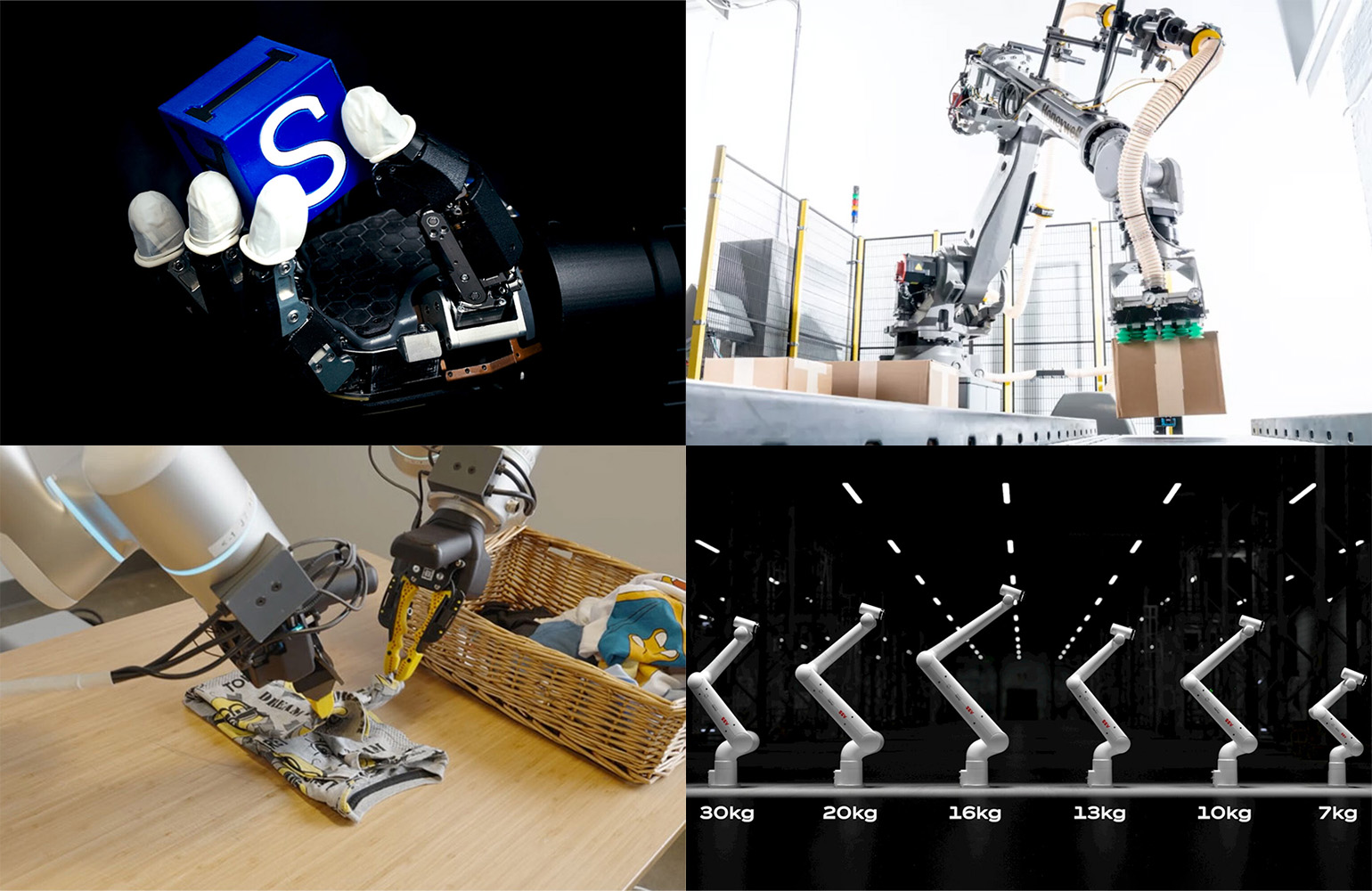
The roundup also points to practical automation launches. Locus Robotics introduced Locus Array, combining a mobile robot, an integrated picking arm, and AI-powered perception for fulfillment work. ABB launched its PoWa cobot family, saying the systems offer higher payloads and performance than earlier offerings and target a market expected to keep growing rapidly through 2028.
Taken together, those items reinforce a clear pattern: robotics is advancing not only through moonshot concepts but through the steady refinement of systems meant to do real work in warehouses and industrial settings. The industry’s commercial center of gravity still lies in environments where labor shortages, throughput pressure, and measurable return on investment can justify deployment.
Money and scale are rising fast
Funding remains a key signal of investor appetite. The source text says Pudu Technology raised nearly $150 million in a new round and claimed a valuation above $1.5 billion. Capital of that scale suggests investors still see room for meaningful growth in industrial and service robotics even after years of hype cycles across adjacent AI markets.
At the more ambitious end, Tesla’s stated plan to begin Optimus production at Fremont in the second quarter and build toward a first-generation robotics plant capable of producing one million units annually shows how aggressive the humanoid narrative has become. The same roundup notes Tesla is targeting 10 million Optimus units with a new Texas plant. Whether those goals prove realistic or not, they signal that some of the largest players now see robotics manufacturing scale itself as a strategic contest.

An industry entering a tougher phase
The legal dispute cited in the roundup, with a German court issuing a preliminary injunction against Elite Robots’ German division in a copyright case brought by Teradyne Robotics, is another marker of maturation. Industries tend to become more litigious as their stakes rise. Patent and copyright battles are rarely signs of a carefree frontier; they are signs that market positions and proprietary advantages are becoming more valuable.
The most useful reading of April, then, is not that one company “won” the month. It is that robotics is diversifying into a more complex industrial system. Software frameworks, fleet analytics, warehouse autonomy, collaborative robots, humanoid production plans, investor capital, and IP disputes are all part of the same picture now. The sector is not waiting for one defining future. It is building several at once.
This article is based on reporting by The Robot Report. Read the original article.
Originally published on therobotreport.com